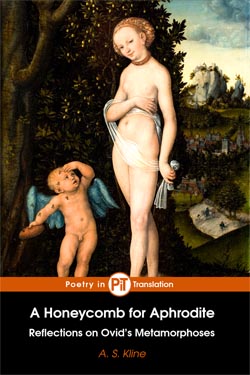
A Honeycomb For Aphrodite


Reflections On Ovid’s Metamorphoses


HOME                                                                            DOWNLOAD


A. S. Kline © 2003 All Rights Reserved

This work may be freely reproduced, stored, and transmitted, electronically or otherwise, for any non-commercial purpose.


                                                   ‘For joy’s sake, from my hands,

                                                    take some honey and some sun’


Osip Mandelshtam.


                                                  Contents


I. The Golden Honeycomb. 5

II The Dual Paths of Art10

III The Structure of the Metamorphoses. 16

IV Ovid’s Interest in Myth. 27

V Nature,The Matrix. 32

VI The Power of the Gods. 54

VII The Nature of the Male Gods. 64

VIII The Nature of the Goddess. 85

IX Justice, Moderation, Order and Rights. 104

X Anger, Vengeance and Destiny. 115

XI Magic and Prophecy. 128

XII Fate and Error134

XIII Lust, Love, Sexuality and Betrayal143

XIV Loyalty and Marriage. 153

XV Pride and Vanity. 161

XVI Respect and Impiety. 169

XVII Crime and Punishment178

XVIII Ovid’s attitude to War and Violence. 182

XIX Tenderness, Pity, Pathos and Regret187

XX Ovid’s Civilised Values, the Sacred Other192

XXI The Later Influence of the Metamorphoses. 210

XXII The Wings of Daedalus. 216


There is a myth that is at the heart of the myths. It is a myth of Crete, but annexed to a myth of Athens, and it contains a metaphor, a set of metaphors, about art. Beautiful in itself, and ultimately mysterious in the power of its associations it refers beyond itself to the whole artistic, perhaps also the whole scientific project. The central myth is about Theseus, and Ariadne and the Labyrinth at Cnossos, but parallel to it and interwoven with it is the myth of Daedalus, the maker.

Daedalus, sculptor and inventor, craftsman, and artist, is said to have been an Athenian, a son of the royal house of Athens, so that, from the first, he represents Pallas Athene’s values, Mind and Intellect, the gifts of the virgin goddess, she who grants clarity to the eye and resilience to the heart, who gives deftness of hand, and inspires simplicity of line, she who fuels the Athenian desire for form, for inner dialogue, for transcendence. Daedalus’s statues are said to have been almost living. He is the creator of the sculptural third dimension, the wide-open eye, the extended arms and stride. A myth is made, that Ovid partially retells (Book VIII:236) explaining how Daedalus in jealousy flung the boy, Talos, his apprentice, and son of his sister Perdix (or Polycaste), from the heights of the Athenian citadel, sacred to Pallas Athene herself. Talos had invented many things including the saw, and compasses. He is transformed into a partridge, a sacred bird. This story gives a pretext for Daedalus’s banishment from Athens. Driven away from mainland Greece he takes his art to Crete, to the court of King Minos, son of Jupiter the divine, and Europa, that girl whom the god, disguised as a bull, stole from Phoenicia, from Asia.  Minos is the lawgiver, and ruler of a hundred cities, lord of Crete the beautiful, cradle of Greek civilisation.

The story reverses history. Athens gives arts to Crete, whereas Minoan Crete, joyful and full of the graces of life, gave its arts, in truth, to mainland Greece. It gave delight in the word and the dance, in ritual and decoration, it gave lightness of touch, and above all its understanding of feminine values, of the Great Goddess, that lady of the wild creatures, of honey and the hive. She is the Phoenician Astarte, and the laughter-loving Aphrodite her Greek equivalent, she is Cybele and Artemis, she is the triple-goddess at the core of the oldest myths. She is shadowy and magical, glimpsed in faience figurines, in the forms of the bull-leapers, and in the ivory knots, and the golden bees, of Minoan art. Perhaps it was her figure, now lost, that once crowned the lion gate at Mycenae, supported by those wild beasts on either side. Perhaps it was her conical carved stone, taken to Greece, that became the navel stone of oracular Delphi, the centre of the earth. Mainland Greece absorbed Crete. Crete, in turn, gave a swift-flowing delight, and passed on that flow to Greek civilisation, a richly female set of values, contrasting with the masculine dynamics of the sky-gods of Olympus. The Goddess became Aphrodite, and Artemis, Hera, and Athene, or in Ovid’s terms Venus and Diana, Juno and Minerva, the goddess as virgin and as wife, as magic power and fatal presence, the goddess in her many manifestations, wearing her many masks, showing her many faces. That Cretan legacy appeals to Ovid. It is his natural mind-set. It is where his heart lies.

In Crete, the first of Daedalus’ creations was the wicker-frame in which Pasiphae, Minos’ Queen, driven by passion, disguised as a heifer, mated with Neptune-Poseidon’s white bull from the sea. Crete of the bull-leaper frescoes, and the double-headed moon-bladed axes, gives also this mysterious story of unnatural love and procreation, the dream of passion creating monsters, creating the Minotaur half-human, half-bull, a metaphor for Minos’ power. Daedalus then made a Labyrinth (Book VIII:152) beneath the palace of Cnossos, in which Pasiphae’s child, the Minotaur, Asterion, might be imprisoned. The self of humanity, part creature, part human, is locked away inside the maze of inner being. An image of that buried continuity with the animal world, which is also a buried challenge to our civilised existence. Outside, in the free air, Daedalus also created a dancing floor for Ariadne, the creature’s half-sister, daughter of Pasiphae and Minos, sister of Phaedra. It was a space where the Cretan delight of ritual movement might be exhibited, in that society where women, as Plutarch says, in his Life of Theseus, took part freely in the games, as at Sparta. Ariadne is one more incarnation of the Great Goddess, her dance a bird-dance perhaps, of the ritualistic mating partridges of Phoenicia, or a maze dance, echoing the labyrinth beneath her feet, or a dance of stars and constellations, or a dance of the bees in front of the hive, signalling the path to their flowered pastures.

Athens arrives, male assertive power, in the form of Theseus, to suborn the goddess and end the tributes of mainland Greece to Minos and Crete. Ariadne betrays her country and her father, but, acting as the goddess, gives Theseus the means to enter the labyrinth of self, destroy the creature within, and return, so destroying the emblematic power of Minos.  Theseus in turn then abandons and betrays her (BookVIII:169), Athenian power and indifference scorns the goddess that gave it values. Ariadne is rescued by Bacchus-Dionysus. They are related, since he is a grandson of Cadmus through Semele, while she is a granddaughter of Cadmus’s sister, Europa, through Pasiphae. He sets her diadem among the dancing stars, as the Northern Crown, the Corona Borealis.

Daedalus meanwhile, persecuted by Minos, has made wax wings for himself and Icarus, his son by Naucrate, one of Minos’ slaves (Book VIII:183). Warning his son to keep to the middle way, far from the extremes of the heavens and the earth, they take to the sky, flying eastward. But Icarus in pride, curiosity, and the first intoxication of this new artistry, flies too high, too near the sun, the wax melts, and he plunges down into the waters that are named after him, the Icarian Sea.

Daedalus buried him on the island of Icaria, and then turned westward, touching down over Italy, at Cumae, near Circe’s Mount Circeo, a peninsula, once an island cut-off by marshes from the mainland, north of modern Naples. There, Daedalus dedicated the waxen wings to Apollo, the god of art and prophecy, and built a golden-roofed temple for the god, in which his prophetess the Sibyl might live. There, Aeneas will come to speak with her (Book XIV:101) and be guided on the paths of the dead, to the dim regions of the underworld, to pluck the golden bough, and meet with his dead father, Anchises (See also Virgil: Aeneid Book VI).

From Italy, Daedalus flew on, and reached Sicily, and the court of King Cocalus, at Camicus, where he built a fortress (perhaps the site of the ancient city of Acragas, by Agrigento), and solved the task, set him by the King, of threading a Triton shell, by luring an ant, with honey, through its windings. Finally Daedalus created a golden honeycomb for the goddess at Eryx. This shrine of Venus-Aphrodite, and her red doves (both her sacred birds and a name for her priestesses), in the northwest of Sicily, famous in the ancient world, is situated on a high and isolated hilltop on the coast, visible from land and sea for many miles. Diodorus Siculus, Diodorus the Sicilian, tells the story. Daedalus made for the Greek goddess, she an incarnation of the Cretan goddess of the creatures, of the sacred doves and bees, a golden image, a symbol of the hive of art, with its waxen cells, artificial and elaborate, made by the living industry of the bees, and filled with flower pollen, to create the honeyed liquids of the goddess of love, her dripping comb.  Bees were of the Goddess, and the priests, the king-bees, were also guest-masters to Ephesian Artemis. (Pausanias Book VIII.13.1). And the bees are emblems of creative art, those bees that made their wax on Pindar’s lips as he slept just above the road on the way to Thespiai (Pausanias IX.23.1). The complex myth of Daedalus ends here, in fragmentary myths that take him ultimately to Sardinia, where we finally lose trace of him. He has become a component in the wider stories of Theseus the hero, and of Athens.

The myth cluster is ancient and powerful. Daedalus the maker is inextricably bound up with the story of Minos and Pasiphae, Ariadne and Theseus, which in turn links Crete through Europa to Phoenicia, and the Theban story of Cadmus. Asia, Crete, Athens, Italy and Sicily are tied together. Though Minoan Cretan civilisation antedates the Athenian, the Cretan myths have been incorporated into the mainland Greek myths, and juxtaposed with the heroic tales of Theseus, a later Athenian King. So Daedalus finds his place in Ovid’s Metamorphoses, not at the beginning of Ovid’s historical sequence, but at the apex, Book VIII, at the centre of the whole work. There is the artificer: the artist: the maker, at the very core. The myth complex associates him with the Goddess and her worship, she appearing as Pasiphae, Ariadne and Aphrodite, the multiple masks. It associates him with the arts, and with their symbol the hive, and the honey of the hive, product of a living creative act, of discipline and ritual, of intelligence and industry.  It associates him also with the dance of mind, with the dancing floor of the heavens and the earth, with the starry goddess and the sacred circuit of her crown, she the half-sister of the bi-formed Minotaur, and a consort of Dionysus, the wild and untamed. And it associates him with the prophetic oracular powers of Apollo’s priestess, at Cumae, so that Apollo, the civiliser, and Dionysus the inspirer are both present, the two poles of art, frenzy and form. Within the one myth, then, are many metaphors, but above all there is the division between Crete and Athens, between Dionysus and Apollo, between feminine and masculine values, between on the one hand the dancing floor and the golden honeycomb, and on the other the labyrinth and the temple. Between the fluid and free, and the highly-wrought and constrained. The free-flowing honeyed dance and the buzzing golden hive are set against the introspective and tragic journey of self, against the uplifted pillar of worship, and the created house of binding destiny for mind and the gods. ‘They say the oldest shrine of Apollo was built of laurel with branches brought from the groves of Tempe. This shrine must have been in the form of a hut. The Delphians say the second shrine was made by the bees, from bees’ wax and feathers.’ (Pausanias Book X.5.5).


Ovid is a transmitter of myths in the Metamorphoses, but not of all the Greek myths or all the modes of those myths. What fails to interest him is as vital as what does, and even his choice of main theme, the changes undergone by human beings and others, the metamorphoses of men and women into creatures and trees and flowers and natural forms, of gods occasionally into creatures, and heroes into gods, that choice of theme is consonant with his values and sympathies. I would suggest that Ovid is primarily a transmitter of values I would identify with the Great Goddess, with the feminine pole of experience, with the fluid and mortal and graceful and sacred, and that he largely steers away from the values embodied in Greek tragedy, and away from the Epic values of masculine force and power, of cunning and intellect. The Metamorphoses disappoints those who look to it for dark explorations in the labyrinth, for Aeschylus, or Sophocles or even Euripides. It equally disappoints those who look to it for the formal constructions and workings of destiny, religion and empire, for the epic values of the Iliad or Aeneid, or the towering structures later evident in the Divine Comedy. The closer links are to the Odyssey, and its meandering narrative, its story of the hero returning from Troy linking fascinating incidents, though Ovid himself is less interested in Odysseus, than in the wanderings among myth, less interested in masculine ingenuity and power, than in feminine beauty and that dance which lacks a fixed central character: the descendants of the thread of the Metamophoses are the journey of Chaucer’s pilgrims, the garden and the days of Boccacio’s tales, or Rabelais’s literary voyaging. Ovid is a Cervantes without a Don Quixote, a Goethe without a Faust.

          Approach Ovid from the wrong angle and he appears slight, a mere tale-teller. Where are Homer’s Troy and Achaea, Virgil’s Roman Empire, Dante’s cities of Dis, Italy and God? Where is that grappling with human extremes of the Greek tragedians, or Shakespeare’s tragedies? Searching for those themes in him is I think a fundamental error, an error of perspective, perhaps a certain lack of sympathy for the complex of values that Ovid represents. Those values were understood, perhaps subconsciously, by Western civilisation. Not only have Ovid’s charming tales, with their strong visual impact, entered the European bloodstream, but the values of the Goddess entered too, along with them, and tempered the European world-view: emerging in Shakespeare for example as the profound perspective of his heroines as the ‘souls’ of his male protagonists, much as Beatrice is an aspect of Dante’s soul, and tempers his political harshness and formal intensity with the softness of love, and mercy.

          Indeed the aspects of the myths that interest Ovid are not wholly determined by his choice of theme. He selects carefully, he retells carefully, and he returns again and again to his core values, not in a rigid and monolithic way, but in the fluid and graceful patterns of the dance. Ovid flies on Daedalus’ wings, but constructs no deceptive infernal labyrinth, and builds no solid temple to a pre-determined prophetic destiny. Ovid lays out that choral space for the goddess, and he builds her a honeycomb of gold, filling each cell with something sweet and nurturing, something closer to the dancing Graces, the three who give, receive and thank, and closer too to that living Minoan hive where the Cretan Lady of the Creatures could take her place among the beauties of nature and the loving mind.

I want, in this work, to identify the values around which the dance of the Metamorphoses takes place, and examine the honeyed cells that are its beauty and charm. Ovid does not laugh out loud with, and at, the world as he did in the Amores and the Art of Love, he smiles instead, throughout the Metamorphoses, with the smile of acceptance and delight.

          Of the dual ways, that of tragedy and epic on the one hand, dealing with the extremes of human experience, and that of moderation and humane values on the other, Ovid chooses the latter, the ‘middle’ way that Daedalus advises Icarus to choose in his flight, though to no avail. Ovid’s keynotes I suggest are three, Nature, the Goddess (and her values) and Pathos. Nature, primarily as beauty and refuge, the place of resolution: the Goddess as love and compassion, magic and feminine power: and the pathos of fate which is suffered and endured. Ovid wishes to engender not awe and catharsis, not the clash of giant forces, but the awareness of beauty, empathy, and the normal human condition. And he does it because it is his own innermost pre-disposition. It is the natural mode of his mind And in identifying with those values, so that they are almost disguised beneath the surface of his thread of stories, he transmits them to Western culture, so that they re-emerge constantly, and flow towards the values of the Renaissance, the Enlightenment and Modernity. His focus is on men and women, gods and goddesses, entangled in love and fate, flawed by the common failings of pride and jealousy, desire and anger, caught up in a pattern of harm, or potential harm, and resolution, but without the extreme anguish and crushing guilt of tragedy, or the grim power of epic. Certainly he re-tells myths which have immense tragic potential, and were treated by tragedians elsewhere, Pentheus’ death (Book III:511) at the hands of the Bacchae for example, or Niobe’s fate (Book VI:146), both of them victims of their own pride and impiety. But the majority of the stories he recounts are gentler, softer, and subtler. He is interested in charm, beauty, and decorative values, morally in empathy and pity rather than ruthlessness, in kindness rather than cruelty, in loyalty as well as disloyalty, in moderation, forgiveness and acceptance as well as excess and punishment. And those values are not lesser, more trivial, less worthy of interest, they are in fact the fundamental values of a modern society bound together by the recognition of rights, the workings of compassion, and the acceptance of the unequal and perverse workings of chance and intent. Ovid’s way is an almost Taoist understanding, partly visible in Epicureanism and Stoicism, of the inexorable flow of all things, a realisation of the dangers, and consequences of mindless action, an instinctive humaneness, empathy and love of peace, and a delight in Nature (including human nature) as the matrix of birth, life, sexuality and death. Even without the complex enhancements (and distortions) of Christianity, those ‘pagan’ values, existing in the Greek and Roman world, would have been passed on into the life of the European intellect. They emerge for example in Venetian painting, in Mozart’s music, in Tolstoy’s novels, in the Romantic Movement, in some form in most of the great art of Europe.


But surely ‘The Metamorphoses’ has no structure? Certainly it is not the Divine Comedy, nor does it unfold like a Shakespearean plot. The approach is different, but neither the dance nor the honeycomb is an unstructured entity.

The thread of the dance, the necklace on which Ovid strings the myths and stories is History, the mythological history of Ovid’s world: and each tale must be threaded in its proper place so that it can all be told, ‘from the world's first origins to my own time’.

The result of each story is a transformation. Caught in some way by fate, his mythical characters end in a natural resolution. They find refuge from their unhappiness in nature, or are made part of nature in punishment for their sin, or, if they are heroes identified with Rome, they are raised to the skies as gods. And Ovid returns again and again to the same themes within the stories, each set of the dance circling around the central atmosphere he wishes to create, one that transmits his values. The dancing floor belongs to Ariadne, the values are the values of the Goddess, and the dance is hers: the necklace, which is also an encircling crown, is hers.

A thread of time: a necklace of stories: a series of dances. Each cell of the honeycomb, of history, is filled, with the honey of myth. How long does it take to complete the dance, to fill the honeycomb with sweetness? Fifteen nights, fifteen books, from the dark of the moon, from Chaos, to the full moon, the shining splendour of Augustan Empire. The moon is the Goddess, and her light that waxes, and will wane, is the light of alteration, change, the transformations of the world. Ariadne and her Maidens dance, while the Fates, the Goddess in triple-form, spin the thread of that dance, the dance of events, and the story of humanity. And at the end what is left is the honeycomb, the golden creation, its cells filled with sweetness: the creative act has led to the ‘timeless’ creation. Yet by opening the work, to read it once more, the thread is taken up, the dance unfolds again, time is conquered through time, the music repeats, the story is told.

Muthos, is an utterance. Muthoi are the traditional stories of the gods and heroes. Plato first uses muthologia, mythology, to mean the telling of stories. Collections of Greek mythological tales existed before Ovid. Aemilius Macer, a friend of his, translated the Ornithogonia of Boios. Nicander of Colophon had written another. Parthenius, the Greek, tutor to Virgil and Tiberius, had written a Metamorphoses. And there are mythological references throughout Homer, Hesiod, the Homeric Hymns, the Greek dramatists, Pindar, and the other Greek poets. Ovid’s sources were many, the selection process his own. The theme of transformation is strung on the thread of history. Not a formal history, since Ovid is dealing mostly with the pre-history of myth, but a loose history. He places myths in the sequence accepted by the poets, starting with ‘ancient’ times, and progressing through the tales of the gods and early heroes from Thebes, Argos, Athens and Crete, until we reach the hero cycles of Hercules, the Seven Against Thebes, and the Trojan War. Along the way we see the effects of Greek expansion across the Mediterranean, and into the Black Sea, as tales are set in the colonies of Sicily and Lydia, Caria and Thrace. We have glimpses too of the Theban Confederacy and the Minoan Federation. Then we have the myths of Rome and its supposed Trojan origins, of Aeneas and Romulus, ending in the genuinely historical material of the Caesars. Combined with skilful connections between the stories, the effect is of a seamless tapestry of tales, a work of art in a very visual sense. The weaving of the tales is part of the charm of the work.

Ovid tightens the structure, with echoes between the books. In Book X two thirds of the way through Orpheus sings the stories, while in the earlier corresponding Book V, his mother Calliope, the Muse, sings them. The mock-heroic fight scenes of Perseus and Phineus, the Calydonian Boar hunt, and the Lapiths and Centaurs, are placed in Books V, VIII and XII, to balance and weigh the narrative. And, by pure chance, there is a humble image of the whole work, at its heart, in Book VIII:611, on the table of Philemon and Baucis. ‘In the centre was a gleaming honeycomb.’

Within a largely pre-determined historical sequence, through careful selection and skilful presentation, Ovid creates the effect of continuous flow. What he is creating is a dancing floor, and a honeycomb, not a temple or a labyrinth. The structure has the permanence and transience of history, it is a necklace where one can pick up a bead at any point and examine it independently, or pass over all the beads on the thread, or step back and look at the whole effect, diversity in unity. Or it is a garden, where between the entrance and the exit you can find every kind of flower, so long as it charms and delights. It is an Odyssey without Odysseus.

Woven within the history are the gods and goddesses, and they provide a strong element of continuity, the goddess and the god in their many manifestations, returning and displaying their characteristics. They too are a part of the dance, a vital part, and as masked dancers they afford us recognition of similar forces acting throughout the tales, forces of ‘human’ interaction and passion. Disguised as humans the divinities cause havoc, and interfere with human affairs. Piety is a real need, to be able to recognise, and respect, the divine and sacred. Failure to do so leads to disaster, a result of hubris, of pitting oneself against the greater forces. The gods and goddesses enter into human life: the world of the divine and the human is a continuum. In such a continuum it is easy to fall foul of a deity.

The structural effect of the ever-present gods is echoed in the Roman dimension. Ovid, lightly, displays Augustus and Livia as his Jupiter and Juno. It was Venus-Aphrodite after all who mated with a human, Anchises, to produce her beloved Aeneas, and Aeneas the Trojan was the ancestor of Augustus the Roman. It is Venus-Aphrodite who ensures the deification of Aeneas (Book XIV:566), of Julius Caesar (Book XV:843) and, we might anticipate, Augustus also. It is Venus-Aphrodite for whom the golden honeycomb was made. And it is Venus-Aphrodite, goddess of love, who is Ovid’s goddess, the Muse of the Amores, the Heroides, and the Art of Love. So the doings of Jupiter and Juno and their amusing married antagonisms, provide a mirror image of the ‘gods’ of Imperial Rome, to whom Ovid has the same ironic affectionate half-mocking attitude as Homer and the Greeks displayed to their deities. We might go on to speculate that a few other members of the Imperial family take their place as Greek divinities, Julia the Younger, perhaps, as Venus herself, Tiberius as Mars. Ovid hints at Julia the Younger’s possible role as his Muse, his Corinna, in the later poems from exile (Tristia IV:I:1-48 et al), and involvement with her set may have been the reason for that disastrous banishment.

Given the looser and less-structured approach to his material that was dictated by his interests, the form Ovid adopted, which uses the thread of history, the theme of metamorphosis, the repeated appearance of the Gods and Goddesses, and the echo of the Imperial family, along with a few building block devices to create internal echoes, is extremely successful, and reading the Metamorphoses through gives a satisfying feeling of continuity rather than a sense of unrelated material. Interestingly the mythological content of Homer’s Odyssey is also loosely integrated into the narrative, and the continuity there is often provided by the presence of Odysseus and Athena his protecting goddess. The episodes and locations can seem gratuitous, but are there to fill out the story with interesting incident, and amplify the notion of the Mediterranean voyage. Homer of course relied on his audience filling in further detail behind the mythological references. Ovid’s work, also, delights in the way a well-made necklace does, or a solid stone floor, where individual beads or stones have their own shape and character, while fitting onto the thread or into the space, and making a varied whole. Ingenuity and charm of detail are essential to their harmonious creation. Perhaps his own ideal was the carefully designed mosaic or a clever tapestry, like those Arachne and Minerva weave. (Book VI:70).


The myths for Ovid were the perfect raw material, to be used to reflect a world of Fate, where human beings are subject to external and internal forces, and where the emotions generated form patterns to stir empathy in the spectator. His gods are superior forces, with predominantly human characteristics and behaviours amplified by their divinity. They too are partially subject to Fate, as we shall see later. Nature too can act as force, though natural forces are most often divinely initiated. Behind every numinous aspect of the natural world may be the influence for good or ill of a god or a goddess. And within the human being are the same drives and forces that exist, amplified, in the gods. These are the attractive forces of love and passion, the thwarted forces of jealousy and anger, to which are added the human and selfish forces of pride and greed, the thrill of fear, the agonies of loyalty, the conflicts of inner imperatives, leading to the great ocean of empathy, pity and compassion as flight or punishment, fate and overwhelming force take effect.

          Ovid takes over the Greek world of myth, as Roman culture itself did, and identifies himself with that backcloth of Nature, with the overriding force of Fate, with the drives and emotions of divinities and mortals, but with his emphasis on transient humanity, hemmed in by realities, whose lives generate reaction in us, empathy, and understanding. His approach is not religious in any conventional sense, nor is Ovid interested in extreme behaviour, except as the artist in him, or us, might stare at a grotesque horror in an exhibition, at a murderous Thyestes or a blinded Oedipus. Ovid wishes to create empathy rather than tragic terror. He wants us to identify with the protagonists and feel for them, as he does. So he is more interested in heroines than heroes, in ordinary mortals rather than tragic monstrosities. Likewise it is not the vast sweep of events that draws him, not epic moments, not the wars of the Iliad, or Aeneas’s battles. Ovid is interested more by the possibilities of emotion and experience, psychic changes, and individual reaction. The gods are humanised. Human values are essentially civilised, the raw is cooked, and the wild tamed wherever possible. The human defence against the disorder that breaks in on us is affection, loyalty, endurance, and trust. Nature is ambiguous, often beautiful and beneficent, occasionally cruel and indifferent, a marvellous flow. Ovid is a proponent of civilisation, and of the gentler values of the Goddess, her benign moods and masks. Disorder finds its resolution in renewed order through transformation, rather than catharsis. Tragic terror is evaded, as a response, in favour of pathos, a saddened recognition of human frailty, and the greater powers outside us and within us.

          Despite his lateness in antiquity Ovid is content to tell the myths without analysing them in any way. There is no suggestion that he is interested in the myths as explanations of natural phenomena, other than the ways in which the colours and shapes and behaviours of creatures are charmingly ‘explained’ by their being the results of a transformation. So the swallow, Philomela (Book VI:401), and the woodpecker Picus (Book XIV:320) show markings that reflect their fate.  And the frogs, the transformed Lycian farmers (Book VI:313), and the magpies, the Pierides (Book V:642) echo in their behaviour the humans from whom they derived. Nor is Ovid interested in religious ritual per se, or the patterns of social behaviour that might be reflected in a myth. Rites of passage and human sacrifice, for example, are not central to his focus. Even animal sacrifice disturbs Ovid, the vegetarian. Heroic quasi-religious quest too is outside his scope, despite the appearance of Perseus, Theseus and Hercules, in vignettes from their hero cycles.  When the rituals of religion do appear, those of Isis for example (Book IX:666), they are already softening towards the religion of the personalised deity, of the gods and goddesses of every-man and every-woman, precursors to Christianity. It is interesting that at the holiest sanctuary of Isis in Greece at Asclepios, no one could enter the holy place except those personally chosen by Isis and summoned by visions in their sleep (Pausanias X.32.9). In the Metamorphoses, Isis asserts female rights, and reveals the human face of the goddess, before bringing mercy to Telethusa, and Iphis, in just such a vision. In a similar instance of personal communion Bacchus forgives Midas (Book XI:85) by prompting him to a ritual cleansing akin to baptism.

          It would be right to say that Ovid allows the myths to speak for themselves, and transmits what they contain without comment, except that it should also be said that he is both highly selective in what he presents, and is ever-present in the detail of that presentation, so that he creates by a multitude of little effects the ambience and environment through which his own humane, civilised values are reiterated and reinforced.


Most of the scenery in Ovid’s theatre is pastoral. The stories take place in the open air, or in ancient Greek cities, the size of our small towns, open to the sky, and continuous with nature. It is the world before modernity. Nature is beauty and charm, a place of delight, out of which the gods and goddesses emerge with fatal force, involving themselves in human lives, and evoking a response. Nature is the goddess, in her most ancient, her Palaeolithic and Neolithic, form, and Ovid is telling us that as such she is sacred and enticing, inviolable and nurturing. She is the matrix of humanity and its erotic root. As such she is passive and welcoming. In her sacred and inviolable mode, nature as given to humanity, untouched and mysteriously present, she is virgin, she is Diana-Artemis, the Lady of the Wild Creatures, or Minerva-Artemis, goddess of Mind and invention, of womens’ arts and crafts. In her seductive and erotic role, nature as passion and procreation, she is Venus-Aphrodite, and the magical witches and shape-shifters who are her masks, Circe (Book XIV:1) and Medea (Book VII:1), Thetis (Book XI:221) and Mestra (Book VIII:725). In her maternal and nurturing role, nature as life-giver, she is Juno-Hera, sister-wife of Jupiter-Zeus, goddess of brides and women in labour, she is Ceres-Demeter, guardian of the crops, and mother of Proserpine-Persephone the force of seasonal change, and she is Cybele, ancient fertile mother goddess of Asia, and Isis, grieving wife and mother of Egypt.

          This last mode, as Isis, gives a hint as to Ovid’s preferred role for Nature in the Metamorphoses. It is primarily a place of refuge and resolution. True there is also the experience of the floods that affect Deucalion and Pyrrha (Book I:244) and Baucis and Philemon (Book VIII:611) and the plague that decimates the island of Aegina and torments Aeacus (Book VII:453), but these are initiated by deities, that is by the unnatural forces of the gods and goddesses, applying themselves for ‘human’ reasons to human affairs. Nature itself is mother Earth, the passive matrix of life, whom we see disturbed by Phaethon’s passage (Book II:31), and a sanctuary, a receptacle for that series of trees and rivers, birds, beasts, and flowers, stars, and stones into which mortals are transformed, finding there a refuge from unhappiness, or a mode of punishment that is a resolution, almost a final forgiveness.

Ovid’s interest in an afterlife, and some place of retribution hereafter, is minimal, his views reflected perhaps in the doctrine of the transmigration of souls that Pythagoras teaches (Book XV:143), certainly he is no Virgil or Dante, dwelling on the possibilities of the Underworld. Aeneas’s journey there (Book XIV:101) is passed over swiftly, and Orpheus’s visit (Book X:1) is mainly captured in conventional references to some of the famous inmates of Tartarus. His perception is rather of a natural world, where fate takes a hand, and where the final resolution is not so much judgement as re-absorption, the spirit taken back into the realm of nature from which it came, only transformed. The ancient Greek animist world with its continuity, all aspects of nature even rocks and stars possessing ‘life’, is transmitted through his work, and the natural world of the Metamorphoses therefore feels older than the world of the tragedians, older in many respects than Homer, though in the retelling a Roman veneer is added to the surface.

Nature has a pre-scientific fecundity. Creatures can arise out of matter by autogenesis. They do so in the beginning, after the flood, when, men and women have been re-created from stones, and animal life is born spontaneously from the marshy ground. (Book I:416). Pythagoras, in a structural echo, asserts the doctrine again in his teachings at the end of the work (Book XV:361). Nature too can be violated. The people of the Iron Age reveal the rapacity of the human race, tearing their way into the bowels of the earth, and the land moves from common access, to the light of the sun and the air for example, to private possession. (Book I:125). This is echoed again by Latona (Book VI:313) who declares that sunlight, air, and water are a universal right, free to all. Nature has granted them in common: only humanity creates ownership. The text is asserting that ancient view of things held by nomadic and hunting peoples, an inability to understand how land can be owned, a focus on the paths across territory, and the knowledge of where best to find resources, rather than on demarcation, boundaries and surveying.

Spontaneity may be a feature of a given metamorphosis as well. True, it is often a god or a goddess who initiate a transformation: Jupiter turns Io to a heifer to hide her from Juno (Book I:601), Minerva punishes Arachne’s hubris, then, when the girl cannot bear her punishment, and attempts suicide, pities her and turns her into a spider (Book VI:129), Circe transforms Scylla into a monster out of jealousy over Glaucus, poisoning the pool where the girl bathes (Book XIV:1). But there are occasions when the final re-absorption by nature happens seamlessly, an organic mutation, apparently without any divine intervention. The sisters of Phaethon become poplar trees weeping amber (Book II:344), Procne, Tereus and Philomela are transformed into birds after the horrors of their murderous tale (Book VI:653), Hecuba becomes a howling dog, and is pitied by all the gods (Book XIII:481) , and the city of Ardea a grey heron (Book XIV:566). It is as though Nature is capable, with minimum intervention by the divine forces, of triggering the resolution of their story.  

The Greeks, and Ovid, show a predilection for certain types of change. Of the hundred and thirty or so major transformations of the Metamorphoses, sixty or more are into birds (many of these are lesser known tales), traditionally symbolic of the soul or spirit, and with individual characteristics and markings that allow variety of description and situation. Among the better known, Alcyone and Ceyx, drowned by the waters, become the mythical Halcyons (Book XI:710), Cycnus, mourning for Phaethon, the swan (Book II:367), the Pierides, defeated in their contest with the Muses become magpies (Book V:642), and Scylla, who betrayed her father and city to Minos, becomes the rock-dove (Book VIII:81).

Changes into creatures account for a further dozen or so of the transformations. Actaeon is torn to pieces as a stag, for trespassing on Diana’s sacred pool and seeing her naked (Book III:232), while Iphigenia transformed to a deer is concealed by Diana at Aulis (Book XIII:123). Arachne becomes a spider, altered by Minerva (Book VI:129), Callisto a bear (Book II:466), Hippomenes and Atalanta lions (Book X:681), the Lycian farmers frogs (Book VI:313). And half a dozen intriguing changes reverse the ‘natural’ order creating human beings from ants, the Myrmidons (Book VII:614), or from inert matter like Galatea, the statue that turns into a living girl (Book X:243), and even creating dolphins from Aeneas’ fleet of ships (Book XIV:527).

The remaining third of the metamorphoses, forty or so, are mainly dedicated to the gentler changes into flowers and trees, or to those of a less gentle kind, into water, or, harshest of all, stone, while a handful of girls simply waste away. There are a few transformations into star clusters. A few mortals are deified. And then there is the intriguing handful of changes in sexuality.

The trees are fairly numerous, with a dozen or so instances. Notable among them are the Heliades, the mournful sisters of Phaethon, who become poplars (Book II:344), Cyparissus beloved of Apollo, who is changed into the cypress tree (Book X:106), the incestuous Myrrha who bears Adonis (Book X:431) and oozes myrrh, Dryope the lotus, who unwittingly offends the nymphs (Book IX:324), and loveliest tale of all, Philemon and Baucis who, dying together, are transformed simultaneously to oak tree and lime tree, to remain priests of the temple of the gods after their death (Book VIII:679).

Of the handful of flowers Hyacinthus (Book X:143), who shares his flower identity with Ajax (Book XIII:382), Crocus, whose lover Smilax becomes the flowering bindweed (Book IV:274), and Narcissus (Book III:474) are obvious examples, while Adonis becomes the anemone (Book X:708), and Clytie the heliotrope (Book IV:256). All are ‘lovers’ except Ajax, he being chosen to account for the markings on his flower. Hyacinthus is loved by Phoebus, Crocus by Smilax, Narcissus loves himself, Adonis is Venus’ consort, Clytie loves Sol.

There are eight or more transformations to water, including Marsyas, loser in his music contest with Apollo, who becomes a river (Book VI:382), as does Arethusa pursued by the river-god Alpheus (Book V:572), and Acis, destroyed by Polyphemus (Book XIII:870). Helle, falling from the golden ram (Book XI:194), and Icarus (Book VIII:183), whose waxen wings melted, give their names to seas. The incestuous Byblis becomes a fountain (Book IX:595).

          Stones, islands: a dozen or more mortals reach the inertness of matter. That fate is often attendant on some form of sinfulness. Aglauros is petrified by Mercury for her sin of envy (Book II:812): Battus (Book II:676), and Mercury’s son Daphnis (Book IV:274) for disloyalty. Niobe is punished for her boastful pride (Book VI:267), and Anaxarete for her hard-hearted rejection of Iphis (Book XIV:698). The Propoetides, the sacred prostitutes, are condemned for their lost sense of shame (Book X:220). The Gorgon’s head transforms Perseus’ enemies (Book V:149). Lichas is hurled from the cliffs and turned to stone merely for being an unlucky servant (Book IX:211), while Sciron meets the fate he has offered others, and is altered to a sea-cliff (Book VII:425).

          Cyane, whose pool is desecrated (Book V:425), and Canens devastated by the loss of Picus (Book XIV:397) simply waste away, while Semele, mother of Dionysus-Bacchus is consumed by fire (Book III:273), and Echo (Book III:359) and the Sibyl (Book XIV:101) are fated to become voices only.

          Arcas and his mother Callisto (the Bears: Book II:466), and Erigone (Virgo: Book X:431) are set among the stars, along with Ariadne’s crown (Corona Borealis: Book VIII:152). While Glaucus, the grass-eater (Book XIII:898) and Ino and Melicertes, persecuted by Athamas (Book IV:512) become gods, as do the heroes of Rome, namely Hercules, patron God of the site of the City (Book IX:211), Aeneas the mythical creator of the race (Book XIV:566), Romulus the Founder and his wife Hersilia (Book XIV:829), and Julius Caesar, creator of the Empire (Book XV:843).

Lastly there are the fascinating transformations of sexuality. Iphis (Book IX:764) and Caeneus (Book XII:146), are girls who become boys: Salmacis and Hermaphroditus merge bodies (Book IV:346): and Tiresias, experiences life as a woman and then is transformed back into a man, making him uniquely qualified to testify to the superior pleasure women derive from sexual intercourse (Book III:316). Ovid subversively both attests to the fluidity of sexuality, and to the possibilities of female erotic delight, even self-sufficiency.

 The mix of transformations leans towards the terrestrial, birds outnumbering creatures, and trees and flowers offsetting the waters and stones. Stars and divinities are less evident. Ovid’s and the Greeks’ sights are on the natural world of earth rather than on the starry heavens, love and passion outweigh punishment, and beauty is a beauty of this life rather than some other. So Nature emerges from the tales and surrounds them. It is the matrix from which things arise, spontaneously on occasion, from the nurturing soil and the moisture of generation. The ancient goddess is passively and implicitly present within it, ready to take back into herself failed, unhappy or remorseful spirits, those whom fate pursues or has maltreated, those who have reached their apotheosis, or their stony termination, the unfortunate and the sinful, the loving and the loved.

Ovid evokes nature constantly through pastoral description, sheer visual charm that prompted later a wealth of Renaissance landscape imagery. There is Daphne pursued by Apollo, through the pathless woods and the windblown fields, and along the banks of the Peneus, in that vale of Tempe beneath Parnassus. The girl destined to be laurel: to hurl herself into ‘shining beauty’, into the silence of her own leaves, so that Phoebus held his cool immortal hand against the bark, to feel her still-beating heart (Book I:525). There is Diana, bathing in the still, immaculate pool, where Callisto unveils and reveals her shame (Book II:441), or where Actaeon, stumbling upon the sacred inwardness of nature, sees the goddess naked. (Book III:165). There is Europa, drawn out to sea by sly Jupiter, sitting astride the bull’s white form, while her clothing blows behind her in the breeze (Book II:833). There is Narcissus by another ‘unclouded fountain, with silver-bright water’ that is untouched and inviolate, watching his reflection under the shadows of the trees, and falling for himself, chasing the fleeting and intangible image (Book III:402). Salmacis entwines Hermaphroditus in the pool ‘clear to its very depths’, clasping his ivory-white neck (Book IV:346). Perseus rescues the virgin Andromeda, blushing through her warm tears while chained to the rock above the waves, where he hovers in his light armour, wings fluttering on his ankles (Book IV:706).

There is Proserpine in the sad vale of Enna, that space of Sicilian flowers at the heart of the island, spilling the petals from the folds of her clothing, snatched up by the dark God to vanish with his chariot and horses through the depths of Cyane’s trembling waters (Book V:385). There is Medea at midnight, hair unbound, robes unclasped, stretching her arms above her head to invoke the triple goddess, Hecate, and the powers of the Moon (Book VII:179). There is Atalanta, the warrior girl from Tegea, chasing the Calydonian boar through the deep valley (Book VIII:260).  Philemon and Baucis are shown turning back to see their humble cottage transformed, and the countryside sinking beneath the waves (Book VIII:679). Orpheus gathers the trees and creatures around him (Book X:86). He sings the fate of Adonis ‘dying on the yellow sand’ transformed to the anemone flower, ‘lightly clinging, easily fallen’ (Book X:708)

There is Midas, purging himself in the waterfall of Pactolus (Book XI:85). There is the House of Sleep, where no door dares to creak (Book XI:573). There is Polyphemus’s pastoral landscape, the monster and the lovers, beauty and the beast (Book XIII:789), and there is Glaucus lost to the waves (Book XIII:898). There is the house of Circe, who wears ‘a shining robe’ of witchcraft (Book XIV:223). There is Hippolytus, travelling the shore of the Isthmus, meeting the bull from the sea, ending as a king of the wood at sacred Nemi, where the nymph Egeria ‘melted away in tears’ (Book XV:479). There is Venus, goddess of the whole work, of the leading passion that drives so many of its characters, Aphrodite of Eryx, mistress of the golden honeycomb, loosing Caesar, as a comet, from her breast, to climb above the full Moon, and shine over a resplendent City (Book XV:843). Scene after scene reinforces the feeling of natural beauty, of pastoral setting, of the charm and resilient stillness of nature, its ability to soothe and inspire and transform us.

And Nature is overwhelmingly benign, a sanctuary, a place of refuge, where girls can flee from the god, where desolate mothers and wives can sink to rest, where sins of passion are redeemed in forgetfulness and transformation, where crimes are expunged in the silence of stone, or the muteness of birds and beasts. Only once perhaps does Nature itself cause havoc without a seeming cause, when the tempest overtakes Ceyx, and Alcyone finds his returning body, carried to her by the tide. Nature is repetition: ages, cycles, seasons, circuits, masks. The same gods and goddesses perform similar actions, fresh mortals undergo new but familiar emotions. The same faces possess different names, or different forms have the same, hidden, name. The breeze that rustles through Ovid’s groves and sighs across his meadows and fields is the wind that stirs the oak leaves at Dodona, the secret whisperings of the ancient natural goddess-filled world, of that Dione behind Zeus, of Themis and Latona behind the later goddesses, or of that Lady of the Wild Creatures on Crete, of that lady of the grassy Neolithic plains, or she of the Paleolithic meadows below the cliff-walls, leading to the limestone caves, and their secretive art.

The mood of the Metamorphoses, its lasting impression, is not that of power, of the harsh bright Aegean sunlight, of the dark fires of tragedy, of the bloody sand below the walls of Troy, the blinded agony of Oedipus, the murdered corpses of Cassandra and Agamemnon, Clytemnestra and Aegisthus. It is not torment in Tartarus, or the epic struggles of Aeneas. It is not Odysseus visiting a bloodless underworld where the ghosts twitter like bats in the unfulfilled darkness, or while away the tedium of eternity on the lifeless fields of Elysium. The atmosphere of the Metamorphoses is of human life, on this earth, here and now, in nature, and appreciating nature, describing it, embracing it, finding refreshment within it, taking nurture and sustenance from it, while holding it sacred and inviolable, revering the primal Goddess, and seeing her shining face among the leaves.


The gods in Greek myth are an intensification of the human. Entering the world, interacting with it, taking on the forms and surfaces of human beings and creatures, they initiate events by their presence. They are powers. Mating with mortals they charge history with the numinous, creating human destiny. Fate appears as chance and circumstance, but destiny is divinely initiated. Venus embraces Anchises, the mortal, and Aeneas is propelled on his path towards the creation of the Roman people. Jupiter consumes poor Semele, and Bacchus-Dionysus, is plucked from the destruction. Thetis mates with Peleus, and Achilles already sweeps through the glittering darkness of the Iliad. The first and most potent interference with the human world by a god is always through a pregnant woman. Chosen by lineage or beauty, those fated creatures are the seedbeds of divine intervention. The male gods, Jupiter and his brothers Neptune and Dis, Apollo, Mercury, and Bacchus impregnate the girls who will mediate between the human and the divine. The alien, the indeterminate and unbounded, pierces the world and out of it comes turmoil and the stories. The gods are like flashes of lightning: a human encounters one, and like the effect of a stone thrown into a pool, the ripples of consequence follow. Apollo pursues Daphne, and forever afterwards the laurel is his emblem. Jupiter sees Semele, Juno intervenes maliciously, and the girl ends as a heap of charred ash. Actaeon has a single glimpse of Diana bathing and throws away his life. Dis snatches up Persephone and a whole mythological complex of death and re-generation is set in motion. To see a god, to meet a goddess, is the highest of risks. And to be born of the union of divine and mortal, to be a Perseus or Hercules, sons of Jupiter, a Theseus, son of Neptune, a Ulysses, son of Mercury, or an Aeneas, son of Venus, is likewise to be a constant disturber of human events.

The gods come and go. They visit at a prayer, or on a whim, or driven by a passion. They illuminate the sky, there is a crack of thunder and they vanish. They trouble the leaves, an arrow or a spear flashes: there is a cry and then silence. The waters swirl and a monster or a tempest appears: the following dawn is tranquil, the corpse lies on the sand. The gods are invoked or they initiate. They are intermittent forces, applied at the end of the lever, with a mortal at the fulcrum on whom a myth turns. The gods are transient presences. No one lasts long with a god. In a sense the gods are all one god, and the goddesses all one goddess, each in their many aspects. Intervening they wear the mask of circumstance, and take on the nature of a driving force. Jupiter, Neptune, and Dis in triad, are the primal energy of the three regions of existence, the light of sky and earth, the realm of the sea, and the darkness under the earth. Juno is that similar energy with a female aspect, the sister-wife. As the supreme forces they are angered by impiety, the failure of respect, and angered by potential or real competition from mortals. The supreme power expects recognition and humility. To ignore a god, or compete with a god, or mock a god is to enter the realm of high risk, and to invite retaliation. But merely to be in the presence of a god, to be noticed by a god, to be desired by a god is fateful, perhaps fatal. That is the nature of power, and force. To stand in the intense light, to face the storm-wind, to chance the tall wave, is to meet the god, and meet fate head-on.

          The younger gods are more specialised. Minerva-Athene is the power of the mind, Phoebus Apollo the power of the imagination. To her belong women’s arts, and the creations of the cool intellect, to him the domains of music, poetry and prophecy, and medicine, and archery. Diana-Artemis is the original sacred power of the wild, of essential pre-civilised humanity, of personal integrity and silence. Virgin moon-goddess and huntress, Diana is the touchy, inviolable force of the natural world outside the pale of society, that which we invade and harm at our peril. Her interventions are unexpected and her temperament sensitised. Her nature is an uncivilised, remote, ruthlessness, the primacy of raw nature, the essential life of the body and mind before and beyond language. And Bacchus-Dionysus, the vine-god, is her male counterpart, divine frenzy.

Then there are Mercury-Hermes, messenger and trickster, Vulcan-Hephaestus the smith and god of fire, Mars-Ares, the god of war, and the panoply of lesser gods, of the winds, rivers and seas, and the more ancient masks of the Great Goddess that survive like fragments of ancient sculptured faces in a ruined temple, Vesta-Hestia, Themis and Latona, Dione and Cybele. There is a whole ethos, a paradigm, of spirits and forces, powers and deities, filling the world.

Ovid’s attitude to this divine theatre is one of scepticism. It is a secular agnosticism, a willingness to play with the charm of the concept, without committing to the intensity of belief. His own sympathies were perhaps with the ‘this-world’ thoughts of Stoicism and Epicureanism, and if he is religious it is with the gentle softness of the followers of Isis, and perhaps the proto-Christians, in that Imperial melting-pot of nations which held, suspended in solution, awaiting the catalyst, those chemicals that would crystallise around the idea of a personal god, of the redemption of the meek, and the poetry of a love without bounds.

The face of the god appears and disappears. It is the same power manifested in many forms, which are all one essence. So the many girls pursued by the god, taken by the god, are the same girl, her pale shining face like a reflection of the moon in the water, her fate taken out of her hands, her destiny to be a vehicle for the divine. And the transient betrays them. The gods betray mortals, because their attention moves on elsewhere, leaving them behind, all those lost girls, their beauty vanishing, their lives consumed, and all the aged heroes, their function complete, their conquests, and labours, and explorations over, the gods transforming mortals and passing on by. And as the gods betray women so do their lesser images the heroes, they too betray. Theseus abandons Ariadne (Book VIII:152), Jason is false to Medea (Book VII:350), Aeneas follows his own fate not Dido (Book XIV:75), Ulysses parts from Circe and Calypso (Book XIV:223).

 Power has two major aspects, in its potential and in its realisation. In its potential, power is the remote fire of the moon and the stars, of the rustling in the leaves, of the work of art outlasting this age, of night, and stillness, and silence. In its realisation, it is the lightning strike, the moment of painful insight, intense suffering, fierce desire, shattering passion, of birth, possession, death, prophecy. Every intensity is a god. In its actualisation, power is personal, imminent, transforming, sexual in the deepest sense, while in its potential power is virgin, inviolable, distant, intangible, creating awe and fear, concern and anxiety, respect and reverence. So Pallas Athene, that Minerva of the Mind, and Artemis, that Diana of the innermost essence of being prior to civilisation, are virgin. They stand back from the actual. They intervene through the brain and the nerves. They are a sisterhood, a band of immaculate creatures awaiting human reality, a sacred potency. Venus-Aphrodite and Juno-Hera, on the other hand, represent the sexual, outside and within marriage, woman engaged with the world, as lover, mother, wife and companion. The male gods are one god, actual, involved, as the heroes are. And so in a sense are the involved goddesses. Juno supports the Greeks, Venus mates with Anchises and supports the Trojans, and therefore the Romans. Juno comes to women in childbirth: Venus adorns them with beauty. Venus and Juno play out the antagonism between sudden ruthless passion and civilised, stable partnership. Juno and Venus are part of that spectrum of the goddess that is involvement in human relationships, while Diana and Minerva are that part of the Goddess’s spectrum that lies both within and beyond relationship, in the mind and the body, intricate and personal, intense and secretive.

Power seeks possession, and the gods aim to possess our reality. They are immortal: we are transient. But what is their existence, on Olympus, beyond the mortal, is it endless laughter and feasting, art and joy? Sometimes it seems as though all that immortality only has meaning through their intervention in mortality. As though the immortal only gains being though the splendour of our unique mortal transience, an unrepeatable swift flight towards meaning, and into transformation. Sometimes it seems that it is the mortal story that has absorbed the power, and that the gods are drained of force, until they can return, recharged in the next tale. To take possession is a risk for a god. The prophecies endlessly warn of the son who will exceed the father. A god must be careful. Neptune must leave Thetis to Peleus, lest Achilles surpasses him. The power must be retained. If power is absorbed into the human from the divine, then the forces within us must be reflections, or rather extensions, of the divine, and in some sense they are in competition with it. The passions that rack the human being, sexual desire and love, pride and jealousy, greed and envy, and the emotions that run along with them, anger and affection, loyalty and hatred must be divinely triggered forces operating within us. But the gods will not necessarily tolerate them, in us. And the forces of nature must be divine powers filling the world. At that stage of thought the gods simply vanish, transformed into their effects. So Ceyx faces a storm that reveals some divine backcloth, but which in itself is unprovoked (Book XI:474). Midas’s greed (Book XI:85), Myrrha’s incestuous desire (Book X:298), Narcissus’s self-intoxication (Book III:402), Iphis’s love across sexual boundaries (Book IX:714), Niobe’s pride (Book VI:146), Phaethon’s longing for what is beyond his capabilities (Book II:31), Tereus’s lust (Book VI:438), are outside the pattern of divine vendetta, like that of Juno’s against the House of Cadmus and against the people of Troy, or Minerva’s resentment of competition, or Diana’s reaction to encroachment on her innermost sanctuaries. The forces instead are within: ‘some Fury’ breathed on Myrrha. Niobe’s own pride drove her forward. Midas was in love with the glitter of possession. The passions arise, not always inspired overtly by a god or a goddess, not always from the dictates of destiny, but spontaneously, as echoes of the divine, that go out to meet and challenge and conflict with the divine. To be part of transience, to be mortal, and yet to stand in the face of the gods, to provoke them, to reflect their power from a lesser mirror back on to themselves, to compete with them, is to invite punishment.

So the power of the gods and of the goddess may be inflicted on mortals, for the gods’ own reasons, or may be called down on a mortal because of the mortal’s own actions. The winds and waves, the lightning and flame may take a person unawares, at the dictates of a god’s desire, or a goddess’s need for vengeance, or a mortal may themselves invite destruction, deliberately or in error, walking into the storm, inviting the fire. The spur to the story may be as quiet as recognition of the gods, or a failure to recognise them. Or it may be as violent as rape and murder. It may be driven by the sweet attraction of a god to a girl, or the violent reprisals of an offended deity. Wherever power reveals itself by its tokens, in the intercourse between gods and mortals, or in the intensity of the passions and their outcomes, or in the inexorable working out of crime and punishment, there is the explosion of the divine in the human world, and the beginnings of a new tale.


Jupiter-Zeus, supreme king of the gods, son of Rhea the primal Goddess, and Saturn whom he and his brothers, Neptune and Dis, deposed, is the essential focus of divine power. He is a god of mountains, of heights. Born on Mount Lycaeum in Arcady, hidden and nurtured on Cretan Mount Ida, he rules from Mount Olympus. His chief sanctuary was Dodona, in the expressionless nowhere of northwest Greece, itself once a grove of oracular oak trees, beneath Mount Tomaros, inherited from the more ancient Goddess, Dione. As naked power Zeus is the lightning flash and the sound of distant thunder. He has, in a sense, no real face, and no distinguishing features. He is kingship, Imperial power, neutral, sovereign, and ruthless in its rough justice. When Zeus descends among mortals he must therefore appear in disguise. He is a white bull, abducting Europa (Book II:833) or an eagle snatching Asterie and Ganymede (Book X:143), or a swan mounting Leda (Book VI:103), or he mimics the goddess Diana to deceive Callisto (Book II:417). Arachne depicts his many deceptive forms on the web she weaves: a shower of gold, a satyr, a flame, a shepherd, a spotted snake (Book VI:103). In order to rape Io he hides himself in a covering mist (Book I:587). Through the girls he transmits his divinity, creating heroes and gods, Mercury, Bacchus, Minerva, Apollo and Diana are his divine children by them, Hercules, Perseus, Minos and Aeacus are among his mortal sons.

          As a king Jupiter holds the keys to the distribution of power, and to divine justice. So he is a suppliant’s god, to whom the goddesses come asking favours for their children, their lovers, their protégés. He sanctions in this way the deification of the Roman guardian deities, Hercules (Book IX:211), Aeneas (Book XIV:566), Romulus (Book XIV:805), and Julius Caesar (Book XV:745).

He loves just men, Minos, Aeacus and Rhadamanthus, and sits in judgement over gods and mortals. So he holds the balance in the wars over Troy, and Thebes, and during Aeneas’s struggles in Italy. He allows the workings out of human affairs with minimum intervention, but he preserves the balance between warring sides, and ultimately resolves disorder, and restores order after chaos. So for example he rescues the earth from the disaster caused by Phaethon, and decrees that Persephone spend half her time with Ceres, half with Dis, so preserving the balance of the seasons.  But he is himself limited by other powers. Venus herself declares that he is subject to Cupid’s arrows for instance, as are the other gods (Book V:332), and not only can one god not undo an action that another god performs (Book XIV:772), but they are also bound like himself by Fate, as he advises Venus (Book XV:745) and as he explains to the gathering of gods and goddesses (Book IX:418) who are seeking renewed youth for their favoured mortals. So the myths constrain gods and humans alike: bound yet free, destined by Fate and Necessity, but susceptible also to passion and able to intervene in the course of events, creating its flow. The conflict between freewill and pre-destination is not resolved, merely accepted as an inscrutable aspect of the workings of reality.

Jupiter’s great weakness is his constant betrayal of his sister-wife Juno, a weakness on which Ovid plays with delight. Ashamed and regretful, Jupiter must rescue his lovers or aid his offspring by them. His actions cause pain and suffering. Io, Semele, Callisto, Danae: those girls are to be pitied, fated mistresses, deceived or tormented or transformed by Juno, rivals to be persecuted in revenge for Jupiter’s waywardness. He himself pities their vicissitudes. He sets Callisto and her son among the stars (Book II:496). He pleads with Juno to restore Io’s human form (Book I:722). He is sorrowful at Juno’s deception of Semele, whom he is forced by his own oath to visit in his true form, and softens his fire, though she is still consumed, and all he can do is rescue the infant Bacchus and bring him to full term, making him Dionysus, the twice-born (Book III:273). He protects his son Perseus by Danae, as he does Hercules from Juno’s persecution. Ovid provides comic relief with the sly analogy between the divine Jupiter and Juno, and the as yet mortal Augustus and Livia. The episode with Tiresias as to who has the most sexual pleasure, men or women, is a case in point (Book III:316). Jupiter is both the sly adulterer and the hen-pecked husband. And the wars of the divine brother-husband and sister-wife are amusing and pointed. Even in his marriage Jupiter though constrained by fate and driven by passion, has to strive for balance, and achieve a form of justice.

His fluid, Protean brother, Neptune-Poseidon, ruling the second realm of the oceans, because of his inherent formlessness, like Jupiter, is required to display his (lesser) power in other shapes. He possesses girls while disguised as bull, ram, bird and dolphin. He, rather than Aegeus, having slept with Aethra may have been the father of Theseus (Book IX:1), whose fate was bound up with the bull of Minos (Book VIII:152), and whose son Hippolytus was to meet with a fateful bull from the sea (Book XV:479) near Neptune’s sacred city of Troezen. As a horse-god, white sea-breaker, stallion of the waves, he took Ceres-Demeter, as she grazed in the form of a grey mare among the Arcadian herds (Book VI:103). He himself created horses: invented the bridle, and instituted horse racing. And he was the father of Neleus by Tyro, who was in turn Nestor’s father (Book II:676), Nestor whom Homer calls ‘the horse-man’ (Odyssey III). Neptune having raped Medusa in Minerva’s temple, she bore him Pegasus, the winged horse (Book IV:753). A shape-changer himself, and perhaps identified with Proteus the shape-changing sea-god, he gives that power to Mestra (Book VIII:843), and to Periclymenus (Book XII:536). And as the father of Polyphemus, he pursues that Odysseus who blinded his son (Book XIV:154, and Odyssey I, V, VI, VIII, and IX), over the waters, holding him back from Ithaca, and his Penelope.

Dis, the third brother, god of the Underworld, goaded by Cupid’s arrows into desire for a divine girl, alone appears in his true form, to abduct Persephone, and thereby initiate the cycle of the mysteries, that great vegetation myth derived from the Neolithic, with its line of goddesses and their consorts, that myth that unites the soil with what is beneath the soil, the light with the darkness, life with death, and which found its deepest Greek expression in the rites at Eleusis. Confronted by Cyane, she crying the rights of woman and the Goddess, Dis, angered and almost baffled, carries away the terrified Proserpine in his chariot drawn by black horses, unleashes his subterranean, Scorpionic power, and pierces a road back to Tartarus through the depths of the pool. (Book V:385)

          So the three greatest gods intervene in earthly affairs, in order to procreate their powers, binding earth to the three realms of sky, sea and underworld, driven by the primal force of sexual desire. They are manifestations of the primal urge for continuance of the species, humankind writ large on Nature, and striving to be, and go on being.

The younger gods, Phoebus Apollo, Mercury-Hermes, and Bacchus-Dionysus, are in theory less powerful than the sons of Saturn. All three are the sons of Jupiter-Zeus: by Latona, a Titan’s daughter (Book VI:313), Maia, daughter of Atlas (Book II:676), and the mortal Semele, daughter of Cadmus (Book III:253), respectively. Frozen, in representation, as young men, whereas the greater gods are depicted as mature adults, they must achieve by charm, skill, and their seductive power, what the elder gods achieve by raw force, and disguise. Nearer spiritually to the mortal, and more continuously involved with mortal affairs, their emotions intertwine more deeply with humanity, in subtle ways.

Phoebus Apollo, a sun-god: ‘the Far-Darter’, lord of the bow, an echo of Arjuna, and the Indo-Aryan culture of ancient India: god of art and medicine: god of Delos, his birthplace, of Delphi and Cumae and Asian Troy, the oracular shrines of his divinely intoxicated priestesses, the Pythia, the Sibyl, Cassandra: brother of Artemis-Diana: stirs the mortal world through pursuits of girls, and ensuing relationships that often end in love, in compassion as well as passion, in pity and regret. Pricked on by Cupid, he pursues and loses Daphne, but loves her still in her transmutation to the laurel bough, and makes her his sacred tree (Book I:438). Loving Coronis, he regrets his angry destruction of her for her unfaithfulness, and in his regret, laments for her, and plucks their child, Aesculapius, the healer, who inherits his father’s divine gift, from her dead womb (Book II:612). He loves Dione (Book IX:439), and Chione, their son Philammon receiving his gift of music (Book XI:266), and Isse, whom Arachne depicts with him (Book VI:103), and Dryope, sadly changed through error (Book IX:324).

Apollo is always moving beyond the moment and the mortal. His arrows fly from the bow, helping to punish Niobe with the deadly hum of the shafts that strike her children (Book VI:204), inspiring Paris to sink his barb into Achilles’ vulnerable tendon (Book XIII:481), creating terrible fate, crystallising it, a shaft of sunlight piercing the flesh. His priests and priestesses utter inspired phrases, forming the shape of the future for Cadmus, founder of Thebes (Book III:1), and for Aeneas, ancestor of the Roman people (Book XIII:675). The winged words travel across empty space to strike the mind, and fixate the will. A screaming flock of utterances, a swirling shower of pointed leaves, falls on the one who asks, and tells them the answer to what they failed to ask, in cryptic sentences. Who can ignore a prophecy, however little they believe in its worth?

His child Aesculapius can resurrect the dead, restoring Hippolytus to life (Book XV:479), and Apollo himself heals human hurt, though he cannot heal his own wound from Cupid’s weapon, his love for Daphne (Book I:438). Here, on the borderland of human affairs, in illness, and prophecy, Apollo has effect, and in artistic inspiration, when the mind and the hands and the heart fly free. He is called ‘leader of the dance of the Muses’ (Pausanias Book I.2.5). He competes with and defeats Pan’s reed-pipes (Book XI:146) and Marsyas’ lyre, Marsyas who is flayed, yielding a stream of blood, but transformed into river water (Book VI:382). Apollo’s music lifts the stones that build Megara, and leaves the notes resonating in the walls (Book VIII:1). And he helps Neptune build Laomedon’s Troy, perhaps with the same mysterious, magical harmonies (Book XI:194). Aesculapius, his son, brings the dead to life, while Orpheus his poet, son of the Muse, Calliope, walks among the dead, and is himself killed by Dionysus’s Maenads, his oracular head, speaking Apollo’s prophecies, floating down the Hebros to reach Lesbos at last, where Sappho, perhaps, will continue the immortal song (Book XI:1).

Apollo lives on the sexual edge too. He loves boys as well as girls, as does his Orpheus. Tormented by the loss of what he loves, he pities Cyparissus, whom he turns into a cypress tree, so as to mourn forever (Book X:106) and Hyacinthus, killed by accident, whose fallen body the god cradles, the bloodless face ‘as white as the boy’,  his medicines useless in the face of mortality, holding that Spartan loveliness ‘robbed of the flower of youth’ (Book X:143). Apollo is forever cradling the dead mortal, pitying the extreme, inspiring the beyond-human effort of vision or creation.

Mercury-Hermes, son of Jupiter and the Pleiad, Maia, is also possessed of intriguing attributes. He is a god of exchange. Trade: communication: theft, that not so subtle transfer of property: and the music of the reed pipes and the tortoiseshell lyre that he invented, trading the instruments with Apollo for a golden staff, and the art of divination from pebbles dancing in a basin of water, taught to him by Apollo’s old nurses, the Thriae (the triple Muse) of Mount Parnassus. Jupiter appointed him as the messenger to the gods, and gave him authority over treaties and rights of way, commerce and every kind of reciprocal agreement and negotiation. Mercury is mental dexterity and cunning. He achieves his ends by seductive speech, and the swiftness of his mental passage on winged feet. From Jupiter he gained his herald’s staff with the entwined snakes, the caduceus that brings sleep and healing, on the boundaries of wakefulness and illness. The tales of his early life reveal a strong link between him and Apollo, with echoes of Phoebus’s medicine, oracular power, and musical arts.

As god of communication Mercury punishes betrayal by speech: so he turns Battus, the informer to stone, that dead medium, the opposite of living speech (Book II:676), and as a god of paths, doorways and agreements, he petrifies the envious Aglauros, whose sister Herses he is in love with, turning her own words into a form of punishing contract (Book II:812).

His son by Venus-Aphrodite is Hermaphroditus, with whom Salmacis falls in love and begs to be joined to him eternally. The gods grant her prayer and the two form a bi-sexual product of mind and beauty (Book IV:274). His son by Chione is Autolycus, the master-thief (Book XI:266) whose daughter Anticleia, his own grand-daughter, he seduces to become the divine component of her son Ulysses, the embodiment of intelligence and cunning. So Mercury transmits the power of language, eloquence and negotiation, to the world, in the force of speech and persuasiveness that Ulysses reveals in the debate over Achilles’ arms (Book XIII:123), and that sleep-inducing web of words  that closes Argus’ many eyes.

The worship of Bacchus-Dionysus seems to have originated in Phrygia and Thrace, travelled across the Aegean via Chios and Naxos, and from there arrived at ancient Thebes, so that Ino of Thebes is asserted to have been his foster-mother. He also travelled eastwards to India. He was perhaps a barley-god, consort of the great Goddess as Astarte, The twice-born god of the vine, Dionysus, like Apollo, lives at the extremes. His followers are intoxicated, maddened, lost in the mindless ecstasy beyond responsibility, so that he is a god of the formless, of the void outside civilisation, which is ignored at our peril. Where Apollo brings inspiration and awareness of the possibilities of form, Dionysus brings realisation, and awakening, the awareness of inner powers. The great crime is to fail to recognise and acknowledge him, to fence him out from the civilised centre, or submerge him in mediocrity.

For Ovid, the champion of civilisation, Dionysus is a danger and a seduction. We see the god reaching the Aegean islands, discovered on Chios where he is barely recognised (Book III:597) and finding Naxos where he subsequently ‘rescues’ and marries Ariadne, suggesting his late entry into Greece: finding in Ariadne perhaps his ancient consort, she a mask of the great Goddess in her Cretan form (Book VIII:152), and celebrating with her the rites of hierogamy, the sacred marriage of god and goddess. And we see him involved in Thebes, punishing Pentheus for his failure to acknowledge this new divinity, by means of his Maenads, his ecstatic female followers (Book III:692). Ovid explicitly identifies him with his consort, Venus-Astarte, the evening star (Book IV:1), so he is worshipped by night, on high places, as a god of the no-man’s-land of evening and dawn, a god of the shadowy extremes, and of deep intoxication and its after-effects. And as god of twilight he turns the Theban daughters of Minyas into bats, the creatures of the shadows, for their refusal likewise to recognise his godhead.

How can he be allowed to enter the civilised house? As wine, that which brings mild intoxication. Wine is the cultured face of the god of excess, the god of the night. And so Ovid accepts him, tamed, as Bacchus, god of the drinking party, and the morning after, who benignly and gratefully offers a gift to Midas that, alas, he cannot translate into a useful reality (Book XI:85). Such is the fate of the god, to be misunderstood, and often excluded, like the lynxes, and panthers, his creatures: wild cats.

The gods bring power. Over-mastering power, that of divine justice and order, and retribution, or generative power through their mating with mortal girls, or the subtle powers of intoxication, inspiration and exchange, of revelation, creation, and communication. Caught in the blast of power, human beings become vehicles for its existence in the world, channelling it towards invention and civilisation, or fulfilling a momentary fate to be destroyed by it or transformed. In that bright burst of energy they become transmitters, makers, or criminals, exalted or annihilated. One can acknowledge the forces, or deny them. Either way one must realise the consequences in one’s own life. And in a secular age, an age without gods, the myths continue to fill the mind with their relevance, because from our psyches, the hidden processes of mind, the partially coherent web of mental intensities that we call heart and spirit, our motives and thoughts may emerge, unwilled, showing the aspect of sudden and inexplicable form and direction. ‘There is a god within us’ says Ovid (Fasti VI), ‘when he stirs we are enkindled.’

Psychology is a first vague pseudo-scientific thrust into the nature and behaviour of those mental forces we do not yet understand scientifically. In the meantime the gods of Olympus will do, like the patterns of astrology, as theatre, as analogy, to help us make sense of what stirs inside us. And as the Greeks knew, and Ovid transmits, one must strive all one can to direct life in the right path, but in the end one must also recognise that life itself is greater than we are, and its powers sweep through us and stand beyond us, through repetition, through generation, through inspiration, through action. Who has not felt a thought, an action, an intuition, an emotion, as greater than the self, somehow standing outside it, looming over the self, examining it, until the individual is a crystal turned in the hands of reality? Ovid the civilised man, the Roman, is also a medium for the Greek experience, which is raw, wilder, and more visceral. He transmutes Greek knowledge: he metamorphoses it without betraying it.


The gods are agents of change, forces let loose, direct or subtle in their manifestations, moving and shaking the world. What of the Goddess, that is the set of goddesses who are her masks? She is the womb and matrix, the form and shaping force that receives and reacts, generates and re-absorbs, sends out and takes in. Man does, while woman merely is? Not so, because the reaction of a goddess, has as much power to alter the world as the efforts of a god. Action and reaction are equal and opposite. Tension is a balance of forces. Thought, emotion and sensation, are as much reactive as engendering. To see woman, the goddess, the earth as passive is to fall into illusion, to see the world in the way that an initiator wishes us to see it. The reality is the interplay of giving, and receiving, and returning, the dance of the three Graces. ‘An action goes out into the world’, said Buddha, ‘and no one can foresee all its consequences.’ The world is a manifold, it is what it is entire, and there is only one fate, the Moment, the unfolding of what is out of what was an instant ago, the one continuous inter-connected Now of being. It is what exists for us, as reality or shadow, as sensation or information, as experience or memory. What is: is the only testament of what was. The gods do not act in a vacuum in Greek myth: they interact with the living world.

          So the Goddess is all of those girls, in whom sexuality has its way: those girls who are pregnant with the future, or transformed into the living fabric of Nature that is also the Goddess.  But she is also the mystery of the generative and reactive forces that are embedded deep in existence. She is Diana-Artemis, the changing moon, who hunts, kills and magically re-creates the creatures in an endless ritual, just as Nature hunts us down with age and illness, destroys us in death, and bears the species again in its continual re-birth. As such she is the sacred force of existence itself, ever virginal, the sanctity of life, recognised by Ovid’s ‘Pythagoras’, and her sacred inwardness is not pierced, her veil is not lifted, her grove is not violated, with impunity. At the very least we will be hounded by conscience and guilt, at the worst we will be torn apart and our fluids flow back into the earth that nurtured us.

The Goddess is Ceres-Demeter, also, vegetation goddess of the Neolithic, nurturer of the crops, keeper of the mysteries of the changing seasons, mistress of Eleusis, mother of her own self, Proserpine-Persephone, that goes down into the darkness of the underworld each autumn to return each spring. The Maid mates with Dis in the caverns of non-being, while the Mother mourns and searches. And the goddess comes in the form of Venus-Aphrodite, too, that disruptive power of female seduction, that beauty which only has to exist in the world to attract us to it, a shining presence, that mirror in which the best of us is reflected, that mirror which shows us ourselves in our relative ugliness, and calls us to creation and procreation. She is the evening and the morning star, beauty, love, and the truth that flows from them, transient pity and ephemeral rapture, remoteness and nearness. She is Hera-Juno too, and Isis, wife and mother, goddess of childbirth, jealous of her position, manipulative of her male consort, but fearful for him, protective of him, lamenting over his cradled body, mourning life lost, just as she joys in life given, in her cradled child. She is enduring loyalty, the playful, sometimes prickly, friendship and intimacy of long-lasting love and affection. She is Vesta-Hestia, as well, the hearth and home. And the Goddess is Mind, she is Minerva-Athene, the cool-eyed, remote, inviolate, virgin self, the private, shape-shifting, birdlike intellect, that wings above the world, to pass by as a swallow and touch us, to perch in the rafters and chide and remind us, to swoop as a kite or a kestrel and snare us, to dance above the waves like a sea-mew and aid us in our distress. She is the inspirer of crafts and cunning, of intellect and scholarship, of weaving and navigation, of mathematics and horsemanship, of the loom, the earthenware pot and the flute, and the olive branch of peace. She is the goddess of the domestic arts, protective of the girls who worship her, and the heroes, especially Ulysses, who revere her.

          If the gods have heroes whom they engender on goddesses and mortal women, the Goddess has her witches, possessed of her magical powers, those mysterious women that in turn enchant, and possess. Medea is hers, and Circe, and Mestra. And perhaps too the Goddess is present in the nymphs of the woods and the trees and the waters, those countryside demi-goddesses, the Maelids and Dryads, and Hamadryads, and Naiads, often mourning, like the sad spirits of landscape, creators of that atmosphere that makes us shiver with the far-off blue of hills, or the twilit trees and streams, or the deep shadows of the forests. The Goddess is Nature and is everywhere, in stars and trees, in rivers and caves. She is herself in all her manifestations.

          Juno-Hera is Jupiter’s sister and consort, and queen of the gods. A manifestation of the earlier Great Goddess, her pre-eminent sacred sites were on the island of Samos (Book VIII:183) and at Argos (Book XV:143). Ovid also mentions her famous temple at Lacinium, near Crotona, in Italy. Mars-Ares the war-god, and Hephaestus-Vulcan the smith (Book IV:167) are her sons conceived with Jupiter, and Hebe, cup-bearer to the gods, and wife of the deified Hercules is her daughter (Book IX:394). Tormented by Jupiter’s philandering with mortal girls, she embodies female jealousy, the anger of the betrayed wife, and pursues her rivals and their descendants mercilessly through the windings of the myths, so setting up deep conflict that aligns the gods and goddesses for and against her cause. Ovid slyly points up the analogy with the relationship between Augustus and Livia, in the bickering of Jupiter and Juno, which may have had some grounding in fact during the early years of their marriage. Mark Antony seems to have poked fun at Augustus’ adventures with women, though that may have been mere malice, while Suetonius and others suggest youthful licentiousness, but the Emperor would not have found such slights amusing, and Ovid writing from his Black Sea exile, takes pains later to clear the Metamorphoses of lèse-majesté (Tristia II:547-578). The serious point beneath the surface levity and the caricature is the defence of monogamy and marriage, and the sanctity of the marriage bond. Juno is also a goddess of wedding-ceremony (Book VI:401, Book IX:764). It may seem strange to find Ovid, the ‘master of love’, defending the intimate relationship of marriage, but, as he himself claimed, his life was not his work, and, as we shall see later, the Metamorphoses is often at its most tender in revealing the beauty of long-lasting relationship to us.

          Juno then is the great goddess as woman offended, and she directs her jealous anger towards a series of Jupiter’s paramours. Io, transformed into a heifer is guarded by Argus, the many-eyed, until Jupiter sends Mercury to kill Argus and free her, only for Juno to goad her on an interminable journey towards the Nile, where Juno at last relents, Jupiter repenting of his adultery, and restores Io, who becomes an Egyptian goddess (Isis/Hathor) (Book I:568). Callisto, she turns into a bear, leaving Jupiter to set the girl and her son Arcas among the heavens as constellations (Book II:466), where Juno does not cease her persecution, asking the Ocean gods not to allow the new stars to touch their waves. Semele she deceived, causing Jupiter to destroy the girl with the naked power of his presence in sexual union, though he himself attempts to lessen his own intensity. Semele’s own request, prompted by Juno, condemned her. A god, Dionysus-Bacchus, is born of their act. (Book III:273). Juno is angered by her sister Ino too, another daughter of Cadmus, whose child Learchus is killed by her maddened husband Athamas, while she herself becomes a sea-goddess (Book IV:416) Leucothoe: she, the same Ino ‘of the beautiful ankles’ who was ‘touched with pity for Odysseus’ and ‘rose from the water like a sea-mew on the wing’ to aid him. (Odyssey V.333). She is one of four ill-fated sisters, since Pentheus, the son of another sister, Agave, is destroyed by Bacchus’ followers including his own mother, and Actaeon, her sister Autonoe’s son, transformed into a stag, is torn apart by his own hounds at Diana’s prompting (Book III:165). The House of Thebes has far too much involvement with the gods.

          It is Juno who pursues Latona, in jealousy, driving her from place to place until she finds sanctuary on Delos. There Apollo and Diana are born (Book VI:313). It is Juno who, jealous of Aegina, sends the plague to destroy her son Aeacus and his people (Book VII:501) . It is Juno who lands Hercules with his Labours, hounding him for the sin of his mother Alcmena (Book IX:1), whose own birth labour she prolonged (Book IX:273), resenting his deification (Book IX:211) and it is Juno who even objects to Ganymede becoming Jupiter’s cup-bearer (Book X:143). Neither girls nor boys will enjoy his company, if she has her way.

          Why such intensity of jealousy? The Great Goddess, being originally a vegetation goddess, takes a consort, the sun god, for her own, each year, and sees him die in winter to be re-born in the following spring. The god is at first subservient to the goddess. It is she who must choose her consort. He is hers and no one else’s. When historically the male god eventually usurps her power, and becomes first her equal (competing with his twin, his rival, to be the successor, the tanist, her consort) and then her superior, her resentment and her anger fester. So behind this caricature of Juno, lies the deeper powerlessness of the goddess in the face of male betrayal. From powerlessness in regard to her consort flows her jealousy. All rivals must be destroyed.

That too explains her endless conflict with Venus-Aphrodite, the adulterers’ goddess, and her apparent hostility to sexuality, and the pleasure of sexuality, except in legitimate procreation. She blinds Tiresias for his knowledge of woman’s pleasure in coition, though Jupiter blesses him with powers of prophecy in compensation (Book III:316). She limits Echo’s powers of speech for aiding Jupiter’s profligacy, and deceiving her with words (Book III:359). Ixion was punished for attempting to assault her (Book XII:429). And stemming from Paris’s judgement in favour of Venus-Aphrodite (and her ‘gift’ to him of Helen, the gift of passion and beauty that overcomes mind and loyalty), and his award to her of the golden apple that Eris threw at the marriage of Peleus and Thetis, is Juno’s (and Minerva-Athene’s) hostility to Troy, and to the Trojan race personified in Aeneas. She sends her messenger Iris to destroy his ships (Book XIV:75), and aids Turnus in the wars against him in Latium (Book XV:745). And later, still pursuing his descendants, she unbars the Roman citadel to the Sabines (Book XIV:772). Only Perseus, of Jupiter’s heroic sons, seems to escape her attentions: but then he is an Argive, and of her city.

Juno then is the Goddess in an age of male domination, resistant and jealous of her role. Her more ancient masks are Cybele, the Phrygian Great Goddess, the Mother: and her own sister, Ceres-Demeter, the Greek goddess of vegetation, whose Egyptian equivalent is Isis. Ceres is married to the earth, making love to Iasion, son of Jupiter, in the thrice-ploughed field (Book IX:418), and her daughter, symbolic of the rape of the earth and the fields, by winter and death, is Persephone, the fearful child. Bread is the gift of Ceres and her name is synonymous with it (Book XI:85, Book XIII:623), as wine is with that of Bacchus. The story of Demeter-Ceres and Persephone-Proserpine, the rape of the daughter by Dis, her search for her, her plea to Zeus-Jupiter, and his restoration of the girl to her for part of the year, was the inspiration for the rites at her sacred shrine at Eleusis, the Eleusinian Mysteries (Book VII:425). There the ritual of the earth’s rebirth from winter was enacted, probably involving a plunge into darkness, disorientation of the senses, the witnessing of coition in a ‘sacred’ marriage, ‘re-birth’ and a revelation of associated symbols (an ear of corn etc.), and then return to the surface. Ovid follows the mythic cycle (Book V:332) and reinforces the image of her as the corn-goddess, receiving the first fruits of the harvest (Book VIII:260, Book X:431). Isis is her more personal equivalent, nurturing her worshippers (Book IX:666). In both myths the goddess is the divine mother, and deep love and pathos are bound up in the mother-child relationship.

          Juno, Ceres, Isis, Cybele, are the masks of the wife and mother, the power of the creative womb, and of the fiercely loyal consort, the child-bearer and the spirit of harvest. The younger goddesses, like the younger gods, exert their power in other ways. Children of Jupiter, Diana-Artemis is born of Latona, an ancient face of the primal goddess: Minerva-Athene is born from the head of the god, she is Mind incarnate: while Venus-Aphrodite is the goddess of Love and Desire, born of Dione, ancient goddess of Dodona. Inviolate, inventive, seductive, three faces of woman.

          Diana is the individual woman in her sacred, untouched self, not subject to male domination and power. Virgin, she is remote and wild. She is the cool shadow that runs through the trees, the moon goddess, night-hunter of the creatures, carrying her arrows of moonlight as Apollo bears those of the sun, surrounding herself with her band of virgin followers, the moons of the lunar year, of whom she is the thirteenth. She is Luna, shining in the sky (Book XV:176), and Hecate, witch of the darkness, and she is Diana Nemorensis, her wooden image brought by Orestes from wild Thrace where men were sacrificed to her Tauric equivalent (Book XIV:320), to be worshipped at Nemi in Aricia (Book XV:479). Her Egyptian form is Bastet, the cat goddess, creature of night, and the witches’ familiar (Book V:294).

          Diana-Artemis rightly mistrusts men, and wanders the mountains and forests far from them. She is the violent antipathy to the male that drives the female within herself, and to her own sex, avoiding shame, betrayal, objectification, refusing to be an adjunct or possession of the male, denying him power, protecting her own valid and self-sufficient psyche. She is the upholder of woman’s primal right to be herself, a reversion to the ancient goddess, Nature sacred and untouched. So Procris, distraught, goes to her company for refuge (Book VII:661).

She is a ruthless punisher of those who offend her, even inadvertently, unleashing the powers of hostile nature, plague and death, against the mortal world. She has that cold chill of the moon’s light, its lofty indifference to humanity, its virgin silence and stillness, an orb reflecting light, but of the darkness, and with one face always hidden. So she punished Actaeon, grandson of Cadmus, for inadvertently seeing her bathing naked in the pool, she ‘head and shoulders above all the others’, he straying ‘with aimless steps’. ‘So fate would have it’. And Ovid refers to the myth in speaking of his own error and exile: something seen by mistake was the root of his crime (Tristia II:77-120 et al). Chance is cruel, but ignorance is no defence. Actaeon is transformed and destroyed (Book III:165). Callisto too, ‘weary and unprotected’, whom fate in the form of Jupiter overwhelmed, one of her own band, destined to be exposed, shamed and expelled from her presence (Book II:441). Oeneus, King of Calydon, slighted the goddess, neglecting her worship among the twelve Olympians, and she visited the country with the wild boar of huge size that ravaged the fields (Book VIII:260). Meleager, the prince of Calydon, heir of that House of Parthaon dies as an indirect result, and Diana changes his sisters into the Meleagrides, the guinea-hens, her sacred birds (Book VIII:515). And Chione, who slept with Mercury and Apollo in the same night, criticised the Goddess’s beauty, receiving in return for her words a shaft from Diana’s bow, so that, at her destruction, Daedalion Chione’s father, hurled himself into death, and was lifted by Apollo into the air on hawk’s wings, in transformation. (Book XI:266). She ranged herself with Apollo her brother to punish Niobe for her pride (Book VI:267). Yet she can pity too, on occasion, when man is driven by her to inflict cruelty on woman, so she spirits away the tragic Iphigenia, sacrificed by her father for the sake of a favourable wind for the passage to Troy, and transports her to Tauris, leaving, at Aulis, a phantom hind as a substitute sacrifice (Book XII:1).

          If Diana is virgin wildness, the raw set apart from the cooked, nature separate from civilisation, that inner nature which every woman can reach down into, in childbirth for example when the boundaries of life and death are near (so that she is paradoxically a virgin goddess of childbirth), then Minerva-Athene is virgin introspection, the cool mind of reason, detached from passion. Goddess of the domestic arts, the loom, the olive-press, the flute, Ovid presents her as a goddess of weaving and wool-working (Book IV:31), giver of the olive of peace rather than war, though she is an armed goddess (Book VIII: 260, XIII:640), and a patroness of the Muses who sing for her (Book V:250). Careful of her heroes, Ulysses and Diomede, who carried off her sacred image the Palladium from Troy, she nevertheless punishes the Greeks for Ajax the Lesser’s rape of the virgin Cassandra, as she had transformed Medusa, poor girl, for her rape by Neptune in her temple. No one touches the sacred remoteness of the inner mind, the virgin space of the goddess, with impunity. Nevertheless Ovid accentuates her compassion in his selection. Offended by Arachne she contested with her in weaving and punished her effrontery and her skill by beating her over the head, seat of mind and invention, but then when the girl tried to hang herself, pitied her and turned her into the hanging spider (Book VI:1). And so she saves Cornix, since ‘the virgin goddess pities a virgin’, and turns her into a crow (Book II:566). And turns the falling Talos, plunging from her sacred Acropolis of Athens (Book V:642), into the low-flying partridge (Book VIII:236).

          Who is the youngest of the goddesses, and yet the oldest? It is Venus-Aphrodite, Ovid’s goddess, and the goddess of Rome. She is an incarnation of Astarte, Goddess of the Phoenicians, who in turn derived from ancient Mesopotamia, as goddess of waters and the lands between the two rivers. And so she is also Derceto or Atargatis, fish-tailed goddess of Bablyon and Syria, to whom doves are sacred (Book IV:31). Cytherea is her island (Book IV:190), and Cyprus, ports where the Phoenician traders touched: and her priestesses practised ritual prostitution at Ephesus and elsewhere (Book X:220). She is the goddess of passion, and sexuality, and adultery, herself caught in the act with Mars, in the bed of her husband Vulcan, trapped in his bronze net, and in turn punishing Sol, the sun, who betrayed her, making him fall in love with Leucothoe, forgetting his other loves Clymene, mother of Phaethon, Perse, the mother of Circe, and Clytie who becomes the sun-following heliotrope (Book IV:190). Sol’s heat is an analogy of the heat of passion, and so Sol’s child Circe (Book XIV:1), and his grandchild Medea (Book VII:1), are love-intoxicated sorceresses, and Pasiphae his daughter lusts dangerously (Book IX:714). And Venus is soft and melting as he is, and as touched by pathos. Sol is darkened when Phaethon, his son dies (Book II 381), and struggles to bring to life the lost Leucothoe. So Venus weeps over her consort Adonis (Book X:708) and ‘hates hard hearts’ (Book XIV:623). She intercedes on the side of gentleness and to protect those she loves, asking Neptune to save and transform Ino, who in turn will help Ulysses (Book IV:512) and wishing to ward off old age from Anchises her mortal lover, and father of Aeneas (Book IX:418). Aeneas and the Trojans are under her special care, ever since Paris chose her above all others, and his passion for Helen became the root of conflict, ever since she loved Anchises, and ever since Aeneas carried him on his shoulders from the ruins of Troy (Book XIII:623). Through her soft influence even Polyphemus changes his nature and falls for Galatea (Book XIII:738), while another Galatea, an ivory statue, she brings to life for Pygmalion (Book X:243). In her role of protectress, she asks the Naiads to help the Romans (Book XIV:772), and ensures the deification of Aeneas her son (Book XIV:566), and Julius Caesar her descendant, having failed to avert his murder (Book XV:843), so that she is truly Ovid’s goddess, nurturer of Italian civilisation, and his own amorous works.

          Gentle Venus, who is sweet love, she to whom Sappho sings, she of the immortal smiling face, abhors violence and ingratitude, those symptoms of stony minds. So Diomede is punished for wounding her beneath the walls of Troy (Book XIV:445), and Hippomenes (and Atalanta) for flouting her authority despite the help she had given him. (Book X:681). But she would rather attend weddings (Book IX:764) and give her gifts to the bride, Harmonia (Book IX:394), harmony. And she comes in her own shape, not disguised, always as female beauty, seductive and alluring.

          So we find the Goddess, in Ovid’s work, in all her manifestations, as virgin girl and woman, as lover and bride, as mother and mourner. She is Nature and the inviolate sacred circuit of the moon and stars. She is Mind and the untouched private world of the creative soul. She is Beauty and Love. She is all that is deepest and most complex, all that is least definable and most obvious. She is power, too, but not the power of violence and possession, rather the power to stir the heart and spirit, in the way the younger gods can. So that Apollo and Mercury, art and the word, link to Venus and Minerva, beauty and mind, in a circle of love. And Bacchus-Dionysus and Diana-Artemis keep alive the wild instinct in the civilised human being: keep alive the spiritual sources of our psychic energies, in our biological continuity with the animal kingdom, and the ecstatic inspirations of the night-bound universe beyond us. What is above, and below, is also within.


It may seem at times in the Metamorphoses that the gods and goddesses rampage through myth and history unchecked, disturbing the world, entangling powerless humanity in their vengeance and terror, without regard to any moral scheme. Nevertheless there is a fine balance in the affairs of the divine as it affects the mortal. It is true that certain individuals are singled out by chance or destiny. Those girls whom the gods descend on: those heroes driven through vast voyages, and burdened by great tasks. ‘Noblesse oblige’, and beauty is a form of fate. But there is also no mistaking the yearning of gods and humans for order, harmony, peace and resolution. And Ovid, the gentle manipulator of the tales, is always pushing towards civilisation and the middle way, towards tenderness and empathy. ‘Stranger, my heart is not such as to be full of anger for no reason. Due measure is best in all things’, says Alcinous to Odysseus (Odyssey VII.308). Rarely ironic in the Metamorphoses, Ovid softens the glare of the Greek world, not emasculating it as those unsympathetic to Ovid and Roman culture might claim, but modifying its values, searching behind its power complexes and historical struggles for the older, and younger values of joy, affection and delight, for Crete, for the glitter of the sea-girt islands, and the cool green valleys of Arcady. Ovid had travelled to Athens, and to Delos (See Heroides XXI, for a lovely and loving description of the island). He knew the landscape as he knew the culture. One should always be master of more than one world, he tells us: ‘Cultivate your thoughts with the noble arts, more than a little, and learn two languages.’ (Art of Love, Book II)

Ovid takes the deep power, often dark and disturbing, of Greek art, and transforms it, metamorphoses it, to something sweeter, gentler, drawing on the feminine tenderness revealed in Sappho and the Alexandrine poets, rather than the harshness of Aeschylus or the fluid darkness of Euripides. Sappho’s work, I suspect, secretly delighted him, and I think he loved her island ambience, her poems dancing ‘as Cretan girls once danced, by the lovely altar, their graceful feet treading the soft, plumed flowers of the grass.’ (Fragment LP: i.a. 16). If only we too had her works in whole and not in part.

Moderation is Ovid’s instinct, as it was for the thoughtful Greeks. It’s message is there in the lovely retelling of Phaethon’s myth (Book II:31)  and that of Icarus (Book VIII:183). Don’t fly too high: don’t fall too low. Equally, don’t ask for what is inappropriate like the Sibyl (Book XIV:101), and don’t, like Scylla (Book VIII:1), or Polyphemus (Book XIII:738) seek union with the wrong person. It is there in the punishment for excess, for the sins of greed and envy, pride, lust and jealousy, self-love and selfishness. Narcissus (self-love, Book III:339) and Aglauros (envy, Book II:812),  Cephalus (jealousy, Book VII:661) and Tereus (lust, Book VI:401), Myrrha (incest, Book X:298), Chione (Book XI:266), Arachne (Book VI:1) and Niobe (pride, Book VI:146), and Midas (greed, Book XI:85), all find retribution.

But equally Ovid shies away from vicious punishment, in general. Nature is a refuge and a resolution: a natural justice is executed, through re-absorption and transformation. Where disorder is created, order is restored. So earth is repopulated after the flood, and Phaethon’s flames are extinguished, after which Arcadia is restored (Book II:31). Aesculapius brings life from death so that Hippolytus can be compensated for his fate (Book XV:479), Bacchus is snatched from Semele’s immolation (Book III:273), Persephone’s life is balanced, by Jupiter, between this world and the world of darkness (Book V:332), and he creates a new race to people plague-ridden Aegina (Book VII:1).

Sexual disorder is resolved likewise. Incest gives way to re-generation in the birth of Adonis (Book X:298), Iphis is sexually transformed by Isis (Book IX:666), Galatea, the lovely statue, is brought to life by Venus (Book X:243), and the Maenads resolve the Orphic bias towards exclusive homosexuality (Book XI:1). War and suffering, murder and violence end in peace and forgiveness. Thetis obtains pardon for Peleus (Book XI:346). Troy rises again in Rome and the Memnonides perform a ritual enactment of the fighting in Phrygia (Book XIII:576), Hercules (Book IX:211) and Julius Caesar (Book XV:745) are deified, Augustus brings universal order, and the Greeks turn out to have conquered to a Trojan’s gain (Book XV:418).

Transformation may signal ritual purgation, too. Adonis (Book X:708) and Hyacinthus (Book X:143) are remembered not merely as flowers, but by annual festivals, indicating their religious significance as companions of the goddess and the sun-god.

Jupiter is portrayed as loving the just man, so that he cherishes Aeacus, Minos and Rhadamanthos, and longs to renew their youth (Book IX:418 and 439). Jupiter himself will not go back on his sworn word, often taking his oath on the river Styx, as the ‘conscience’ of the gods, so that he must fulfil Semele’s request (Book III:273), as Sol must fulfil that of Phaethon (Book II:31). Ovid, the lawyer by training, uses the debate between Ulysses and Ajax to display the proper way to resolve an issue, not by violence, but by reason and intelligence (Book XIII:1). The solution to Greek tension and conflict, to epic, and vendetta, is Roman justice.

And above all the gods love piety, which is not, as Socrates mischievously defined it, ‘what is agreeable to the gods’ (Plato: Euthyphro), but the moderation involved in respect and recognition, grace and generosity of spirit, nobility in humble poverty, undying affection, and lifelong loyalty. Again and again, as we shall see later, impiety is punished, that disregard for the greater and truer: that challenge to the natural forces of the world that the gods and goddesses embody: that defiance of constraint and rushing to excess that imperils civilisation: that violence to the moral order that creates ripples of destruction.

The rights of woman are sounded also. Daphne, a follower of Diana, is ‘averse to being wooed, free from men and unable to endure them’, and so Apollo is defeated of his intent, and, transformed, she lives on in the noble laurel (Book I:438). Likewise Pan fails to capture Syrinx, another of Diana’s acolytes, who becomes the reed from which his sounding pipes are made (Book I:689). Bacchic freedom gives the Maenads an erotic self-sufficiency on their mountain heights, such that no man dares to cross tracks with them (Book III:692, Book XI:1). And Polyxena ‘ill-fated, but with more than a woman’s courage’ declares the ultimate inviolability of the female spirit, she who has ‘no desire to be slave to any man’ (Book XIII:429).

Women have their own arts, their own powers of magic and prophecy, and in Ovid, almost for the first time, as in the Heroides, they have their own voice. Ovid uses extended soliloquy to allow women to express their own point of view: Philomela (Book VI:486), Medea (BookVII:1), Scylla (Book VIII:1), Althaea (Book VIII:451), Myrrha (Book X:298), Alcyone (Book XI:650), Hecuba (Book XIII:481). The male voices are limited, the female voices ring out across the centuries, in chorus. The male voices assert, or inveigle, or repent, the female voices cry out, and debate within themselves, agonise, and persuade the heart.


The myths, as re-told by Ovid, reveal the age-old confusion over free will and pre-destination that has so bedevilled the human race. On the one hand events are said to reveal ordained patterns that even the gods must obey, on the other hand individuals are free to choose their path through circumstance, exercising their skills, never sure if the gods will help or hinder, while the gods themselves must argue, and contend, in order to see their chosen creatures safely home. According to one version of myth the Fates are the daughters of Necessity, and not of Jupiter, so that he is subject to them. In another version they are the daughters of Night and Erebus, but Jupiter can intervene to alter things. However no mortal sacrifices to the Fates, in myth, or succeeds in placating them.

We find Jupiter explaining the nature of these immoveable Fates, and their ‘iron rules’ to Venus-Aphrodite, a suppliant on behalf of her Caesar (Book XV:745). The House of the Three contains inscriptions on bronze and iron where ‘all things are written’ and there she will find the fate of her descendants ‘cut in everlasting adamant’. And again we find Jupiter bemoaning the ageing of his favourites and those of the other gods (Book IX:418) telling them that : ‘Even you and I, too, fate rules.’ Yet earlier he has explained to them his actions regarding Hercules’ deification, it being apparently within his gift (Book IX:211), and he, with other gods, can resolve the dispute over Athens between Minerva and Neptune (Book VI:70), while he can determine Persephone’s eventual fate (Book V:533) and can grant Aurora’s request to him, to commemorate her son Memnon (Book XIII:576). And there are many other interventions, apparently self-determined by Jupiter. So his role is ultimately perplexing, bound by the knot of necessity rather than the kiss of circumstance, and yet unbound: working the paths of destiny, as their visible presence, and yet himself determining the rights and wrongs of the situation.

          The heroes are subject to the anger of the gods, and their desire for vengeance, they too are driven by destiny and overmastering fate. Ulysses is pursued by Neptune, driven across the face of the waters (Book XIV:223), Hercules (Book IX:1) and Aeneas (Book XIV:75) by Juno, forced to their labours and their journeys and their battles, so too the Greeks are pushed towards Troy by the web of destiny (Book XII:1), Achilles and Hector towards death and glory. Events or non-events, action or inaction, precipitate response. To neglect a god may be as bad as to compete with a god. Either path defies their supremacy. Merely to be born who one is, to be a love child of Jupiter, is enough to trigger the pattern of history: to make a decision as Paris has to, in favour of one goddess and to the detriment of others: or to retaliate against a god’s child as Ulysses does against Polyphemus. The gods are sensitive. The pattern will unfold, offence, anger, desire for revenge: intervention, and persecution.

It is almost as bad to fail or offend a sorceress, a repository of female power, a face of the goddess. So Jason will bring Medea’s wrath upon himself (Book VII:350), and Hippolytus will suffer because of the attentions of Phaedra (Book XV:479).

The gods, goddesses and heroes, entangled in the extended story, in the tale of deeds, are enmeshed by destiny. It ties a rope around their necks, a sword-belt around their waists, it throws a net over them, holds them in the web of passion and desire. The heroes are driven by the demands of the future to create and to found cities, or to destroy them, to search for home or endure exile, to adventure or to settle. Cadmus founds Thebes, Perseus achieves marriage with Andromeda, Theseus destroys Cnossos, and Jason opens up the Black Sea trade routes. And the rope of destiny that binds is also a necklace: the necklace is a woman’s sex, or the circle of a marriage ring, the mouth of a birth canal, or the path to a crown: and the crown is the circuit of a realm, or the circling of a divine constellation.

Ovid is intrigued by the conflict of destiny and freedom, since all his instinct is for freedom, the freedom of the creative writer, and yet much of his life’s material is the ‘given’ of the novelist, the stories and the texture of society. Destiny is not his forte: he shies away from epic and tragedy. Neither satisfies his desire for lightness, joy, taste, judgement, moderation and appreciation. Beauty and love should escape inexorable truth. Ovid loves the resolution more than the horror. Hercules’ torment under the shirt of Nessus, Caesar’s death at the hands of the assassins, must give way to deification. Ovid never relishes the implacable fury of destiny. His lost tragedy was his ‘Medea’, but the story of Medea is not a tragedy in the strict sense. Ovid’s delight is in the visual, the telling image, the intricacies of feeling and response, in relationship, and not in its destruction wilful or otherwise. So Oedipus: Agamemnon and the house of Atreus: and the working out of the Trojan War, those arenas of intensity are only touched on in the Metamorphoses. True they do not play to the theme of metamorphosis, but that is in itself only the idea of change, and some material enters the work on the slenderest of pretexts. If he had so chosen he might have incorporated more of those dark doings. But Ovid’s later Roman world was moving towards a world of greater personal choice, of greater moral subtlety, and to values based on intimate personal relationship, even with the divine, as exemplified by Isis and Jesus. Destiny cannot be truly reconciled with moral choice, and the Greeks and Ovid puzzle over it. Religion involving deities always has to choose between gods of limited power allowing human freedom, or gods with complete power even the power to allow crime, or generate unmerited suffering. The first option leads to the concept of bounded gods who themselves suffer force and fate, in ways similar to humans, the Greek concept: the second option leads to the concept of gods who encompass guilt, cruelty and suffering beyond our comprehension, and therefore ultimately our sympathy, which is a Hindu, Jewish, Christian and Islamic concept. The gods are ultimately either impotent or immoral.  

Nor can Destiny be reconciled with free will: that is the ability to generate actions through internal mental processes identifiable with the self and character. Either free will is allowed, and the gods have limited ability to foresee or control events and human decisions, the patterns of history are open: or the gods have total control, and events and internal human choice are pre-determined, in which case choice is an illusion and character is imposed on the self rather than developed. Ovid believed in education and learning, in development and creativity, in self-control and moderation, in character and personality, in degrees of freedom. It is a modern view. For us, from a scientific viewpoint, the future cannot be wholly determinate, even in principle (due to quantum indeterminacy), and is certainly not so in practice (due to its complexity and non-linearity), and the external world is therefore partially, but significantly, open and incomplete. More importantly, the result of our internal mental processes, our choices, is often mainly dependent on ourselves, on memory, knowledge, pre-disposition, capability: on character and personality: in other words, the world frequently comes to be through us, and not despite us, however much we may be influenced by external factors, or ‘programmed’ by our genetics and experience. As in the quantum world, even though, statistically, events and choices are often consistent with a pre-determined pattern of probabilities, individual events and choices have an inherent unpredictability, and tiny changes in quantity can make vast changes in quality, a tiny force can move a great lever; a single thought can move the world. Free will is the ability of the ‘self’ to be itself, to process information from within and without, not randomly, since that would be meaningless, but consistently. That set of processes is the self. 

Clearly Ovid, as we do, accepts that chance and circumstance and character itself create patterns; that events can acquire a fateful character, a certain inexorable quality, running from inception through suffering to death or resolution, but it is less obvious that he accepts the idea of destiny, even that powerful concept of Roman destiny that gripped his society. There is often an ironic gleam in his eye, concerning the Empire, a playful and delightful smile at the corners of his mouth, even in darkest exile when it is most subdued, even in extremis. If he did concede the concept of destiny, it is not to the foremost in the Metamorphoses. Personality and character are far more important, in responding to chance and circumstance. Anticipating Shakespearean tragedy and the novel form generally in literature (there are, arguably, exceptions among the novelists, such as Hardy and Melville), Ovid’s protagonists are driven more by the nature of their circumstances and their own characters, by fate, rather than by ‘destiny’ in any of its forms. Without destiny to drive the mechanism, then ‘tragic’ art must rely on the concept of the flawed personality or flawed circumstances to create the seemingly inexorable nature of the tragic pattern. The modern ‘tragic’ protagonist is then simply one who is caught up in damaging events outside themselves, beyond their control, and perhaps exacerbated by their own failings.

So the Metamorphoses represent a world in transition, in a state of metamorphosis itself, even in Greek times, a transition from the concept of inevitable pattern within events, the world of Jupiter and Neptune, Juno and Demeter and Dis, the older gods, to a freer world of personal choice and loyalties, the world of Venus-Aphrodite and Apollo, of Mercury, Minerva and Bacchus-Dionysus, the younger gods. The older gods create the pattern for the heroes, but it is the younger ones who create incident and aid, who help and further, who pity and resolve the suffering caused. So necessity becomes relationship. So the noose and the net become the kiss and the free embrace. So destiny gives way to fate, and Nemesis to the unforeseen. Tragedy gives way to pathos, and sacrifice to repentance and regret.

The younger gods take on relationship with mortals, unlike the older gods. Jupiter is here and gone in a flash of lightning, crackling across the sky, striking the sacred oak, leaving ashes like a funeral pyre. Neptune swells, and his tumescent wave rolls over the girl, Mestra, on the shore (Book VIII:843), or he takes Medusa disguised as a sea-gull in the open portico of Minerva’s temple (Book IV:753). Then he slips away with the tide. Dis holds the struggling Proserpine in his arms, as he drives his chariot into the underworld. Here suddenly in the bright sunlight of Enna, then gone, from the living to the dead (Book V:385). But the younger gods become the affectionate lovers of mortals. Apollo of Hyacinthus (Book X:143), Venus of Adonis (Book X:503), Bacchus-Dionysus of Ariadne (Book VIII:152), Mercury of Chione, and her daughter Anticleia (Book XI:266, Book XIII:123). The relationship between god and mortal is deeper, subtler.   Now the gods too are more vulnerable, to love, to pity, to Eros-Cupid, to chance and misfortune. Hyacinthus, and Adonis are accidentally killed (though their deaths relate to older myths of divinity and its consort). Apollo and Venus weep over the bodies of the beloved. The transience of mortal life is obvious, and no sacrifice or catharsis, no prayer or invocation can evade time and death. In the marketplace at Athens, says Pausanias (Book I.17.1), ‘is the Altar of Pity, not known to everyone.’ It is the ancient altar of the Twelve Gods, excavated on the north edge of the Agora.

Does Ovid believe in the Underworld, a destined place of retribution or bliss, in the region beyond death? Aeneas’ visit to the shades is brief to the point of reticence (Book XIV:101). Ovid is more interested, in that passage, in the Sibyl’s error, in asking for eternal life but not eternal youth, so that she is doomed therefore to become a mere oracular sound, speaking from the shadows, ‘the fates will bequeath me a voice’. Pythagoras teaches instead the transmigration of souls (Book XV:143) ‘why fear the Styx, why fear the ghosts and empty names, the stuff of poets, the spectres of a phantom world?…Souls are free from death.’ Perhaps Ovid shared that belief. Did he come to metempsychosis through working on the Metamorphoses or did the idea of the book of changes come to him from the idea of repetition, of survival, of spiritual transformation? The life after death is as questionable to him, perhaps, as the reality of destiny. The necessary is not necessarily good. Ovid appreciates the Roman project, civilisation for the world, appreciates it even more when he is exiled from it on the borders of Scythia, and so he endorses the Roman destiny, a popular sentiment. Perhaps he convinced himself it was so. He does not however write the epic of Augustus.

The age of the heroes is brief, caught between the older myths and the world of late Athens and early Rome. When it is over, destiny and myth have worked themselves through. Now there is history and circumstance, character and event. Athens and Rome are the modern world in embryo. Ovid is already a master of nostalgia, of the idyllic dream, looking back to the charm of the past, to the sun-drenched, or sea-misted landscapes of an earlier world, a world that never was, just as much as the Homeric poets looked back to an earlier Greece, or the Medieval world to the Magical Court of King Arthur. The best that we can imagine never exists except within the kingdoms of our own thoughts. Is it a true thread the gods spin, words that tell the tale ‘from the world’s first origins to my own time’, or were these things that never happened, but are delightful to speak of? By implication, perhaps a mischievous implication, the Rome of Augustus (Book XV:843), is also a mythical Rome, the one that never existed, as opposed to the one that does exist? Ovid ends the Metamorphoses quickly in what is a formal invocation of Roman greatness, avoiding too much of the required sycophancy. Faithful to himself, Ovid’s attempts to conform, even in the darkest of the poems from exile, are transparent. There is always a little golden, laughing imp dancing in the light behind the words.


Destiny is a weight on life and the spirit. Necessity weighs us down. The slow churning of epic and tragedy can feel like death to the soul, rather than catharsis. While fantasy and the story can free us, the working out of a foredoomed reality could only be destructive of the psyche. Who has not felt the weariness of a life too clearly seen? Who has not escaped into the world of art or fresh personal relationship in order to destroy their sense of the inevitable? There are even texts that are too painful to read again, stories that are too inexorable to endure. Nowhere is the contrast between the web of destiny and the desire to alter destiny more apparent than in the contrast between the sorceresses of myth and the seers, the witches and the prophetesses. That they are usually both female suggests that woman embodies both aspects of life, as on the one hand the inevitable chain of procreation, the constant cycle of birth, life, death and new birth, the cycle of the moon, and the mother, and on the other the magical power of erotic love, and the intense desire to possess the loved freely through whatever means are available. Woman is a daughter of a daughter back to the beginning, a prophetic cave within a cave, enfolding wombs of myth out of which spring heroes and gods. Man is a product of her body. She is also the unpredictable transformation of the erotic: that which attracts man, entices and delays him, and from which he may seek to free himself, and may succeed, though not without cost.

As we might anticipate, Ovid expends far more words on the witches than on the seers. His prophetesses appear in order to add colour to his stories, rather than to initiate major events. The prophetic episodes are brief. The Sibyl confirms Aeneas’ fate (Book XIV:101) but we hear none of her ravings from the cave that Virgil conjures for us. Ocyrhoë warns Aesculapius and tells of his fate and that of her own father Chiron (Book II:633) only to be stopped by the Fates from further prophecy. Ovid does not give us the chilling effects such a prophecy might have had on Chiron. Tiresias, we hear, receives prophetic powers (Book III:316) and warns Narcissus’ mother Liriope of her son’s potential for self-intoxication, while Manto, Tiresias’ daughter calls the women of Thebes to prayer (Book VI:146). Themis, possibly an ancient moon-goddess of Thebes to whom the sphinx was sacred (Book VII:759),  prophesies for Deucalion, to guide the rebirth of the earth (Book I:313), and overrules Juno to give a condensed version of the tales surrounding the War of the Seven against Thebes (Book IX:394) and to trigger Jupiter’s comments on the way fate binds the gods. She too had prophesied the theft of Atlas’ golden apples from the Garden of the Hesperides (Book IV:604). Themis represents that ancient world of oracular destiny that drives the epic and the tragic. But oracle and prophecy though touched on lightly in the Metamorphoses do not stir Ovid’s interest deeply. Prophetic words lead into heaviness and the closing of iron portals. Ovid is in favour of light, and the opening of the door into the garden. The Raven proclaims ‘I spurn empty prophecies’ though to be sure it meets the predictable fate of the informer, in a tale that has subtle echoes of Ovid’s own fate (Book II:531).

The witches, the sorceresses are more interesting to him. Here is woman with the power to create magical and erotic change, to enhance and defy fate, even if only temporarily. So Circe, and Medea, are given extended magical roles, while Mestra (Book VIII:843) and Thetis (Book:XI:221, though strictly a goddess) appear as erotic shape-shifters, gifted such powers by volatile Neptune.

Medea (Book VII:1), a face of the triple moon-goddess (Diana: Luna: Hecate) is infatuated by Jason, as, like Circe, she experiences desire for a mortal man. Her herbs and magic, inspired by Hecate, protect her lover from the fiery bulls, create conflict among his enemies, and send the dragon to sleep. She has the power to extend Aeson’s life, and does so, to attack Jason’s enemy Pelias and does so, though here she overreaches herself and has to flee. But still she is in the end forsaken by Jason, her erotic nature thwarted, and she commits crime in Corinth (where she destroys his new bride with fire) and Athens, eventually vanishing, escaping death ‘in a dark mist, raised by her incantations.’ The power of the erotic therefore works for good or for evil, depending on circumstances, essentially geared to the object of love as long as that object is mutually committed to her as the lover. Medea is portrayed as elusive, in contact with occult powers, devious (her name may mean ‘cunning’) and passionate.

Circe, daughter of the fiery sun (Book XIV:1) is first seen enamoured of Glaucus. She is erotically charged ‘no one has a nature more susceptible to such fires’, perhaps by Venus herself. Spurned by Glaucus she too punishes his preferred love, Scylla. Walking the waves, she then poisons Scylla’s bathing place with the juice of harmful roots. Later we find her capturing and enticing Ulysses, and transforming his crew to wild beasts. Again the use of magic is ambiguous, both erotically helpful to her, and yet harmful against those who are not her lovers. Ulysses eventually escaped her delaying tactics, but we see her again enamoured, this time of Picus of Laurentum, spurned by him, and revenging herself on him and his lover Canens with all her occult resources.

Magic then can aid the erotic, but as we have seen it fails in the end to hold the lover, and the witch is frequently spurned or abandoned, finding satisfaction only in her powers of revenge. Magic is here a temporary overcoming of fate, a command that is usually doomed to fail, but, as Ovid portrays it, a bold attempt at erotic freedom, especially for woman in the face of male choice, and male dominance. While Thetis submits in the end to Peleus, having run through all her forms, Mestra is sold repeatedly to men, but is able to escape them.


Circumstance and character are fate. While heroes as we have seen are caught in the toils of pre-determined destiny, ordinary mortals are more often the victims of chance events beyond their control, or are the perpetrators of unwitting error. Ovid is strongly focused on the drama of human beings caught in the net of misfortune, on their emotions and decisions, the stress and strain on their characters, and the pathos of their suffering. These are tragedies in the sense not of something inescapable, ineluctable and pre-ordained, but tragedies in the sense of the damaged life, of hurt that is undeserved, and of pathos that generates spontaneous empathy. These people are innocent, and yet they suffer, as Ovid declared himself innocent of the crime for which he was exiled, claiming that it was ‘an error’. He was in the wrong place at the wrong time, as so many characters are in the myths, punished for being who they are, or where they are, or for their attributes.

So beauty is fate for all those mortal girls loved by the gods. Daphne (Book I:438)  and Io (Book I:587), Syrinx (Book I:689) and Callisto (Book II:401), Europa (Book II:833) and Semele (Book III:273), Leucothoe (Book IV:214) and Arethusa (Book V:572). They are transformed, or enter into the divine, or give birth to men and gods. And beauty can be a fate for mortal boys too, as it is for Ganymede and Hyacinthus (Book X:143). Beauty is something beyond. It is a mantle that falls over the mortal body, shining, characterless, but unique and fatal. It is the power of appearance, the attractive force of that magnet the human form is for us. It may hide cruelty and coldness, or warmth and innocence: it may be a hollow statue or a living inspiration, a decoration or a symbol. It may be a vanishing moment that shows us the heart-aching transience of what we love, or a consummation pregnant with destiny. The gods, those human-like forces enter the early world, and as a fire or a shadow, or disguised as a creature, they penetrate reality. They destroy and they inseminate, and they wrench lives apart. And the girl or the boy is a victim of his or her own loveliness. ‘Destroy this beauty that pleases too well!’ cries Daphne (Book I:525). Ovid’s attitude is empathy for the victim. His aim in the retelling is to evoke pity and the girls are portrayed as innocent, persecuted, a quarry in the hunt, escaping only in transformation, their beauty returning to the beauty of nature, or in death. Failure to escape means becoming a pregnant vehicle of the future: giving birth to a hero or a god. 

Fate may equally be to be caught up in the affairs of the gods, to be condemned to speak or act, and to be punished as Tiresias is for speaking the truth (Book III:316), or by being taken too literally as the Sibyl was, condemned to endless life but without youth (Book XIV:101). It may be fatal to trespass into the sacred realm, too. Actaeon does, seeing Diana naked, and is punished for his error (Book III:138), as is Dryope, straying beyond the accepted bounds (Book IX:324). Or to cross the paths of the wielder of magic as a rival in love, as Scylla and Canens are afflicted by the angry Circe (Book XIV:1, Book XIV:397), or Glauce (Book VII:350). The divine, the superhuman, is cruel, and innocence is no defence.

Fate may descend on the innocent mysteriously, too, through sheer mischance, through that malignancy that sometimes seems to inhere in events or in nature. So Eurydice treads on a snake (Book X:1). So Pyramus and Thisbe are thwarted, in that sweet story (Book IV:55) which Shakespeare mutilated in A Midsummer Night’s Dream, and redeemed himself by transmuting into Romeo and Juliet. So Deianira unwittingly sends the shirt of Nessus to Hercules (Book IX:89). And so the storm descends on Ceyx (Book XI:410), out of the blue.

Or others may be our fate. It is enough to be born in the wrong place, to be a person caught up in human affairs, in the destinies of the great. So Ovid evokes pathos for Ino, innocent victim of Juno’s enmity against the House of Cadmus (Book IV:416), and Andromeda, punished for her mother’s failings (Book IV:663), for Hecuba, blameless queen of fallen Troy, and her courageous daughter Polyxena, doomed to be a sacrifice to the ghost of Achilles (Book XIII:429) and for Cassandra, raped in Troy, and murdered later alongside Agamemnon (Book XIII:399).

Worst of all is to be the innocent victim of another’s failing: another’s sin: another’s crime. To be a victim, is to be a sacrifice, to a god, to a shade, to the fragility of human life. The Greek light falls with the indifferent power of the sun, benign or merciless, over human affairs, and we are caught in the flow. Guiltless we are caught up in the fate of the guilty. Phaethon’s sisters will be turned to poplars in their grief (Book II:31): Niobe’s children will die through her pride (Book VI:146): innocent Philomela will be the victim of Tereus’ lust, and so in a sense will the child, Itys (Book VI:401): while Hesperie will be lost through Aesacus’ pursuit of her (Book XI:749).

Ovid’s emotions are excited by innocence, by the pathos of the undeserved fate more than by that of the guilty. It is a core dimension of his feminine, secular, irreligious set of values. The incident of Polyxena hints at his attitude to sacrifice ‘No god will be appeased by such a rite as this!’ she cries. He depicts the questionable behaviour of the gods as if it were merely an exercise in aesthetics, and the movement of forces, the faces of power: he is sceptical as to their morality. After all, he may imply, anyone, regardless of morality, a Hercules, or a Caesar, for example, can become a god. Only with his treatment of Isis (Book IX:666), and perhaps Bacchus (Book IV:1, Book XI:85), is there the feeling of a mystery, a truly divine side to experience. Only there is there a feeling of invocation. But, I would argue, what Ovid is in fact invoking is the power of pity, what he finds enchanting is Isis, champion of the abused woman, and the unborn child, and Dionysus who rewards and forgives his followers. Rome was ready for a god of pity, a god of the innocent sacrifice, but here all is predominantly human and secular: and mortal emotion, mortal sadness is greater than divine power.

I would claim Ovid as a humanist, and a transmitter of human values from out of the heart of the myths. Nowhere is that more evident than in his attitude to women. He sympathised with the fate of women, as the Heroides revealed, women constrained in their roles, victims and subjects, punished merely for being there, and punished too for trying to be other than their lot dictated. He has a quiet admiration for Medea and Circe, for Polyxena (‘take the hands of man from virgin flesh!’ Book XIII:429), and Daphne( ‘free from men, and unable to endure them’ Book I:473). His heroes are often faintly ridiculous, creatures of force and bombast, his true heroes, his ‘heroides’, are women, mostly modest, reticent, brave, victimised, sometimes courageous, passionate, forceful. And Ovid avoids the more deliberately criminal women of the myths: there is no picture of adulterous and murderous Clytemnestra here, or perjuring obsessive Phaedra, only echoes of their activities. His women of terror are the Maenads, or Procne: maddened Furies, the agents of conscience and retribution, enacting vengeance for the violation of the sacred.


Venus-Aphrodite gave birth to the god of love, Cupid, or Eros as the Greeks knew him. His father was Mars, the war-god who committed adultery with Venus in her husband Vulcan’s bed, and who was caught with her in that smith’s bronze net (Book IV:167). Hence derives the aggression of lust, and the wars of love. Or in another version Hermes-Mercury, a phallic god, was the father, and love was also filled with that mental agility of wooers and wooed. Or the goddess committed incest with her father Jupiter-Zeus, and passion inherits that excess and disdain for boundaries. Cupid with his bow and arrows is Venus’ wayward child, causing even the gods to be blinded by passion, just as he is depicted blind: making Apollo desire Daphne (Book I:438), Dis be filled with a passion for Proserpine (Book V:332), and his own mother Venus fall in love with Adonis (Book X:503).

          Venus-Aphrodite is the goddess of the whole spectrum of love, from lust and sexual obsession, through desire and mutual attraction, to long and faithful affection, and even a loving mourning for what is lost. She attends weddings, and she hovers over adulterers.  She binds the loyal, and she encourages to betrayal. Myrtle is her plant, and Aphrodite’s ‘berry’ is the clitoris, as well as the fruit of that tree. The Metamorphoses is a work implicitly dedicated to her, as goddess of the Roman race, but also as goddess of that love, that admiration for the feminine, that is the core of Ovid’s writing. The inscription on the statue of Aphrodite, sculpted by Alkamenes, standing near her shrine in the Gardens at Athens, proclaimed that: ‘Heavenly Aphrodite is the oldest of the Fates.’ (Pausanias I.19.2)

          The Metamorphoses begins almost with that early world where the lust of the older gods sweeps down like the shadow of a bird across the earth, and where the azure sky flashes lightning to possess a mortal girl, or the god takes the emblematic form of a horse or a bull, a swan or an eagle. The animal kingdom is one with the human. Aphrodite, that Astarte of the East, is also the Lady of the Creatures, before Artemis-Diana is split away from her. And the gods are erotic possession, the flailing arms and twisting bodies of all those ensnared virgins who writhe beneath the god’s adopted form, pierced and taken by the primeval urge, like Io caught in the mist (Book I:587): like Callisto, betrayed by Jupiter (Book II:417) ‘as far as a woman could she fought him’: like Proserpine snatched by Dis, crying to her mother ‘with piteous mouth’: like Neptune raping Medusa, even in the temple of Minerva itself (Book IV:753). It is, as Sappho says ‘A whirl of wings from above, beating down through the heart of the air’, it is ‘the wind on the mountain pouring through the oak trees’, and what occurs creates ‘the demented heart’ and the mind of a woman who will ‘love against her will’ (Sappho LP: 1). That is one end of the spectrum. Gods who must satisfy themselves with mortal women, or one step down, and one move less permissible, women who like Medea and Circe lust after mortal men. What is acceptable for the gods is dangerous for mortal witches, and it may end in deceit and betrayal. A step further down again, and it is an urge, obsessive and fraught with risk that runs hand in hand with violence and crime. It is the lust of Tereus, the Thracian ‘savage’, for Philomela that rapes and cuts its way to the mute objectification of woman, in a denial of all she is (Book VI:486). It is the passion of Phaedra for Hippolytus, inspired by Eros who ‘heats my marrow with greedy fire’ (Ovid: Heroides IV), she who is ‘swept away, like the Maenads’, who declares ‘I have no shame’. Phaedra, who in the end commits a crime of perjury to condemn her lover to exile, and his father’s curse (Book XV:479). This is passion, obsessive and destructive, tearing apart human relations, filled with erotic charge. It is man and woman, dazed, inflamed, maddened, or in a conflicting phase rejected, stunned, and angered. It is sexual power in excess, loosed and frenzied. It is the monstrous Aphrodite, the ravening goddess, the equivalent of the Hindu Kali, that female incarnation of Siva to whom human sacrifice was made, or that Diana of the Chersonese whose altars were death to strangers, and ‘stained with murder’ (Ovid Tristia IV.IV:43). It lies behind the myth of Atalanta (Book X:560) who was truly ‘pitiless, but such was the power of her beauty a rash crowd of suitors came, despite the rules.’ The inconstant god descends, the inflamed goddess stretches out her hand, and in the flash of lightning, the click of the shutter, the single profile of the beloved is cast darkly on the white screen of time, the same profile, the one silhouette.

          And Venus-Aphrodite is the goddess of the forbidden, the force that breaks human conventions. Incest is her dark doing. Byblis loves her brother Caunus, and, as she soliloquises, there is divine precedent in that ‘the gods have possessed their sisters’ (Book IX:439), while Myrrha sneaks into her father’s bed: after all, do not ‘the creatures mate indiscriminately’, and surely it is only ‘human concern that has made malign laws.’ (Book X:298).

          But Venus is not merely lust, no mere sexuality. Though she is the prostitute and the goddess of prostitutes, she is the deeper movement of love also. She is committed passion that dies of love for its object: she is a tenderness that stirs the god to pity, and the goddess to heart-broken mourning. She is the betrayed and the betrayer but also the faithful and the entangled. She is the body’s remorseless stirring, but she is also the mind and spirit’s sweet embrace. So Echo wasted away with love for Narcissus (Book III:359) ‘the more she followed the closer she burned’: and Salmacis fused with Hermaphroditus (Book IV:346) ‘hanging there’, twined round his head and feet: and indeed beauty may be loved by the beast, Galatea by poor Polyphemus. ‘Oh, Gentle Venus’, says Ovid, ‘how powerful your rule is over us!’ (Book XIII:738).

And there is the pity of love, too. Apollo, betrayed by Coronis, repented of killing her and ‘groaned from the depths of his heart’ (Book II:612), and so Jupiter groans as he hears Semele’s request (Book III:273) and Venus herself suffers, and complains to the Fates, as she bends over the bloodless body of her Adonis (Book X:708).

Love flirts always with betrayal, eroticism may overpower the heart, the magnetic power of sexuality may defeat the mind. Jealousy may corrupt the lover: that yearning for a wrongful possession of the beloved, a reduction of person to object. The idea of adultery may pierce the loving soul. The adulterer may reject and scorn and abandon the once beloved. Envy or greed or garrulity may prompt the informer to betray the lovers. Theseus forsakes Ariadne (Book VIII:152), Jason abandons Medea (Book VII:350), Aglauros is touched by Envy, jealous of Mercury’s love, for her sister Herse, and is ‘eaten by secret agony’ (Book II:787). The Raven betrays Coronis to Apollo (Book II:596) and truth is his downfall. Scylla betrays her father and her city, Megara, for love of Minos (Book VIII:1), while Clytie condemns her rival Leucothoe, for the sake of the dazzling Sol (Book IV:214) and his daughter Circe condemns the other Scylla in her jealous desire for Glaucus (Book XIV:1). 

One of Ovid’s saddest tales is that of Cephalus and Procris, a complex meditation on suspicion, jealousy and the fatal power of mistrust. Cephalus, himself resisting the passion of Aurora, the Dawn, for love of his Procris, indulges in a fatal test of his wife’s loyalty, almost tempting her to adultery. She flees, and later the situation is rescued, but then Procris is led by an informant to suspect Cephalus, erroneously. She spies on him, and he through a tragic accident, unintentionally kills her (Book VII:661). The story gave Shakespeare, directly or indirectly, at least two of his plots.

Venus then spans the gamut of emotions, and the whole range of actions within the sphere of love. From the violent, erotic acts of possession of the old gods, through the increasing tenderness and affection of the younger gods and goddesses: from the excessive passions of mortals, their incest, adultery and jealousy, to the spontaneous and graceful consent of mutual ‘true’ love, and the enduring bonds of longstanding commitment, and enduring marriage. From aggression to care: from violence to empathy and compassion: from betrayal to unbreakable loyalty.


‘Fortunate bridegroom’, Sappho sings,  ‘the marriage you prayed for has come about, and the bride you dreamed of is yours…Lovely bride, the sight of you is joy: your eyes are honey, and love flows over your gentle face…Aphrodite has honoured you above all the rest.’ (Sappho: LP 112) Ovid was three times married (one marriage was a difficult failure, his second wife died, the third outlived him as far as is known, see Tristia IV.X:41), and he gives great weight to marriage in the Metamorphoses. By doing so, he both offsets the effects of his earlier work in the Amores, and the Art of Love, and the memory of all those betrayed, forsaken and passionate women of the Heroides, and he extends the tradition of Homer’s Odyssey as he did in the very first of the Heroides. ‘…Nothing is greater or better than this’ says Odysseus as he speaks to Nausicaa (Odyssey Book VI:180) ‘than a man and woman keeping house together, sharing one mind and heart, a grief to their enemies and a joy to their friends..’. Odysseus is returning to his faithful wife Penelope, while Alcinous, Nausicaa’s father and King of the Phaeacians lay down in his chamber and ‘beside him that lady, his wife (Arete), brought him love and comfort.’ (Odyssey VII:345).

Ovid produces some of his best effects in the Metamorphoses with stories that contain the warmth, tenderness and enduring loyalty of married love. There is the voice with which Deucalion speaks to Pyrrha his ‘dear wife’ after they alone survive the Flood (Book I:348), there is the pathos of Cadmus and Harmonia’s end (Book IV:563) where both are transformed into serpents, ‘two snakes there, with intertwining coils’. There is the love, equally shared, of the Centaurs, Cyllarus and Hylonome, who sadly die together (Book XII:393). There is the marriage between Perseus and Andromeda, where we see the ‘happy evidence of joyful hearts’ (Book IV:753) a scene which is ancestor to Shakespeare’s resolution of many of his comedies in happy marriages.

And Ovid is moved enough to broaden out into extended stories when he finds real beauty in the situation. So, there is the beauty of the marriage of Baucis and Philemon, the touching nature of their wish, and the sweetness of their ending, transformed into trees (Book VIII:611): there is the pathos of the story of Ceyx and Alcyone, their expressions of married love, the disaster of that tempest, another source of Shakespearean effects, and the sadness of loss and grief at the death of a partner (Book XI:410), an echo of that of Procris: and there is Orpheus finding his Eurydice again in the fields of Elysium (Book XI:1). Each of these scenes benefit from Ovid’s real feeling for enduring love, and he pours some of his sweetest words into the idea of marriage.

And when the bonds are broken, as they are between Procne and Tereus, we see the power of revulsion, the terrible reaction of the wife and her sister to the depths of his betrayal (Book VI:401).

In the Metamorphoses Ovid proves himself the true ‘master of love’ in a manner that goes beyond the witty social commentary, and the dance of lovers, as he portrays it in the Art of Love, and the Cures for Love. I think here he justifies his statements, from exile, that his life was not his art, and that his work had never been designed to corrupt. Reading the Metamorphoses we obtain as strong a view of the beauties of married love, and mutual human commitment, as Augustus himself, in later life, might have desired. And his portrait of the Emperor and his Livia, in the infidelities and bickering of Jupiter and Juno, is itself a witty commentary on yet another aspect of marriage, the frequently non-destructive sparring of partners, the little bouts of anger and spite indulged in by married lovers and friends, tolerated because of a depth of mutual understanding.

Tenderness and irony, realism woven with sensitivity and empathy, that is Ovid’s hallmark, and the sign of his subtlety and the greatness of his art. How badly he has been understood, and how inadequately he has been praised, a master of words so skilful, that it seems easy to do what he does, simple to imitate, whose grace of style can seem, to the careless, a superficial smoothness, and whose beauties can seem, to the unsympathetic, a mere conventional music. Yet it was he who alerted us, in a cultivated Roman way, to that grace and beauty, and whose own literary legacy has made the music seem ‘conventional’, by itself creating the convention that the Renaissance seized on.

It is not always the clashing of weapons in epic, or the extremes of human emotion in tragedy, that express the depths of human experience. They can come to seem like effects for the sake of effect, horror for the sake of horror, and occasionally like attacks of self-indulgent histrionics. Ovid is all for balance, all for the middle way, and the avoidance of that excess. Though he sometimes exploits the effects too, his heart is not in it. He can stray near to bathos and melodrama with his attempts at violence and horror. Ovid speaks more effectively when he speaks about the mythical in terms of the ordinary life, and of the depths of love and pathos as they strike common mortals. Does that make him a poet of the bourgeoisie, the tame middle-classes, of the easily satisfied reader looking for entertainment rather than profundity? I think not. The more I read him, the greater I think the miracle he performed. And all good creative literature is in a sense entertainment. That is its first task. Ovid’s gleaming visual surfaces are not shallows: they are reaches of crystal clear water, their depths seeming near enough to touch.


When the gods step down among human beings, and take on mortal form they run a risk: that of going unrecognised, or worse still of being treated as mere mortals indeed. The Greek gods are jealous gods, jealous of their own attributes and powers, and their supremacy in the areas under their control. Though no god can reverse the actions of another, though the gods of the sky and earth have no powers on the sea or in the underworld, within their own sphere they countenance no opposition. For a mortal to take too much pride in his or her own capabilities, or to feel too much security, to consider themselves immune from the vicissitudes of fate, is hubris. And that bloated human pride in success and wealth, or that vanity derived from great beauty or great skill, is a form of excess. Ovid is a follower of the middle way, and the stories of the Metamorphoses are filled with examples of hubris and counter-examples of a proper humility, a proper recognition of the fragility of human life, and the limited nature of our powers.

          Phaethon begins it, asking a fatal request of his father Sol, the sun god. And a god’s oath once sworn on the Styx, that river of the underworld that is the gods’ conscience, cannot be retracted. Sol grants his son command of the sun chariot, and Phaethon unable to manage the reins, unable to hold the god’s fiery horses, soars high towards the stars, then plunges down, far from the middle course towards the earth, scorching it in passing. Phaethon’s inflated idea of himself and his abilities, derived from his divine parentage, has led him to hubris, to excess. Jupiter restores order by sending the fire of lightning to end the fiery flight, and Phaethon plunges deep into the river Eridanus. Note Ovid’s touch of pity even here as the river god ‘takes him from the air, and bathes his smoke-blackened face’, while his sisters are turned to poplar trees, weeping tears of amber. Ovid’s vivid visual gifts are in evidence throughout (Book II:1).

          Vain Narcissus continues it, spurning poor Echo to fall in love with his own face in the fountain, that ‘fleeting image’. And Ovid fittingly gives the mind intoxicated with itself a soliloquy in which to indulge the sentiment. Narcissus melts away at last, leaving behind the narcissus flower gazing at itself in the clear waters (Book III:339).

          Then the nine sisters, the Pierides, challenge the supremacy of the Muses in singing, and for their part sing their mockery of the gods, how they fled to Egypt and took on animal forms (Book V:294), while Calliope’s reply is instead an assertion of divine mystery, the myth of Demeter and Proserpine, the Mother and the Maid. Beautiful and profound: so that the Pierides in their laughter and ridicule are transformed to chattering magpies. Those who, in their vanity, mock at what they do not comprehend, must expect to be punished by fate (Book V:642). Impiety and pride are inextricably interwoven. To challenge the gods is also to scorn the gods: to believe oneself greater than them, is also to deny them their due respect.

          Ovid is warming to the theme. Book VI recounts three famous stories of pride punished, Arachne, challenging the goddess Minerva to a weaving contest, only to end as a spider forever web-bound (Book VI:1), Niobe, daughter of a Pleiad (and its seven main stars, so she is associated with the number seven), child of Tantalus, boasting of her status, her seven sons and seven daughters, her riches, calling herself ‘greater than any whom Fortune can harm’, challenging Latona, whose own two children are more powerful than an army of mortals. It is Apollo and Diana who kill her offspring with their cruel arrows, and Niobe herself is transformed to weeping stone. (Book VI:146).

          So it goes on, this human excess, and its nemesis, its punishment, since all skill and beauty, all surplus, is a gift of fate, of life, of nature, of the graces, of the powers outside us, and hidden within us, and so must be appreciated, understood, cherished, and respected, not as something of ours, but something given, something shared. And do we not understand this, even in a secular age, that there is a tactfulness of the heart, and a proper humility of the spirit? That the greatest crime of those endowed by fate, is to fail to give back, to fail to give thanks, to fail to open full hands to a world of poverty and deprivation, and then multiply the good by sharing it, by giving, silently, invisibly and tenderly, in that gesture of the third Grace (the trio of Graces are Aglaia, Euphrosyne, and Thalia: giving, receiving and thanking), that gesture of the mother with her child, and the lover with the beloved, delighting in the presence that comes, almost miraculously it seems, from the sources of being, and in our own ability to give to that presence.

          But still Marsyas, the satyr, will compete with Apollo, only to be loosed from the sheath of his skin, mourned by the nymphs and the woodland gods, and the fauns and his brother satyrs, and end as all life is accustomed to end in a river of tears (Book VI:382). Still, Icarus will fly too near the sun in his sudden ecstasy of flight (Book VIII:183), and Chione, mother of Autolycus, will criticise Diana’s beauty and receive an arrow in exchange (Book XI:266), and Ancaeus ‘swollen with pride’ will challenge Diana’s power and gain his death wound in the fields of Calydon (Book VIII:376). Phoebus-Apollo, Diana-Artemis, Minerva-Athene, the remote gods, the detached ones, art, nature, skill, the divinities of what is given to us, our natural and innate capabilities, our hidden powers: these are not good divinities to mock or to oppose. They are the givers, we are the takers, and so a proper respect, a proper distance, and a proper humility are needed in addressing what we do not yet understand, the faculties of mind: the structures of the brain: the processes of our inner selves.  


Woe to those who fail to recognise a god, or who mistake a god and worship the wrong god. These divine strangers in a human form, not caught in stone or marble, on a frieze or a tombstone, but living forces in the world, are guests to be welcomed. When the god or the goddess arrives and is known, the heart shakes and the mind is dazzled, the eyes mist and the body trembles. Life breaks in, and it is the oldest, perhaps the only sin, to fail to know or respect its power to change us, to bless us. Life, Nature is the given, the sacred, that which humankind did not create, that which we violate at our risk. Grace is the movement of the mind and heart that welcomes the gods with humility: those hidden powers: those inner forces that shape our existence. And Impiety is that lack of respect, that failure of recognition that punishes and kills the spirit. 

          The Metamorphoses is full of those moments of disrespect to the gods, those challenges to them from pride, that insolence that claims for itself, for its own conscious self, the powers of the psyche that are fuelled from deep within. Every art, every act of skill, every Olympian moment, every flowing phrase, every tender perfection of the loving gesture, is a gift of the psyche, of the deep spirit inside us, of the forces whose effects psychology recognises, but of whose nature it has no true idea, and for whose identity it has no meaningful names. They are not occult forces, there is only a mystery, and perhaps religion is just the response to the power of that mystery, that we barely know ourselves. Delphi gave human beings the two greatest challenges, in the inscriptions over the temple of the god, ‘Know yourself’ and ‘Nothing in excess’, the two things most difficult for the conscious mind, because the secret of both lies hidden, and within. Time after time in the Metamorphoses, in the Greek myths on which Ovid draws, the protagonists fail both tests. Through pride as we have seen, through vanity, through envy, through greed. And through lack of recognition, through an impious indifference, a wilful abuse of the sacred.

          There is Pentheus, imprisoning, and threatening to torment, Bacchus, who, as Acoetes, has fallen into his hands. But just as the god’s powers transformed the sailors into sea creatures, into dolphins with tails like ‘the curved horns of a fragmentary moon’, so now ‘the doors flew open by themselves, the chains loosening without effort’ (Book III:692) and Pentheus, that ‘fighter against the gods’ (Euripides: Bacchae), angered into attacking the mysteries is torn apart on Mount Cithaeron, at the hands of the Maenads, at the hands of his own mother, Agave, his limbs scattered like leaves stripped from the branches by the autumn frost.  The daughters of Minyas deny the god also, and are changed to bats, creatures of Dionysus’ twilight hour, the borderland of night and light (Book IV:389). So too the serpent of an unintentional impiety rises again to haunt and transform Cadmus and Harmonia (Book IV:563). So Erysichthon shatters the sacred tree, offending Ceres-Demeter, ancient nature goddess, and is punished by her opposite power, that of Famine (Book VIII:725). So Myrrha makes wrongful use of the festival of Ceres, sleeping with her father, Cinyras, without his knowing her identity, while the Queen is absent from his bed, observing the rites (Book X:431). So Atalanta and Hippomenes commit sacrilegious union in the cave of the Goddess (Book X:560), so Midas is punished with ass’s ears for denying the judgement of the gods (Book XI:172), the Greeks are punished for Ajax the Lesser’s rape of Cassandra in the temple of Minerva (Book XIV:445), Acmon for denying Venus (Book XIV:483), and the Apulian shepherd for mocking the nymphs (Book XIV:512).

          But the gods are not mocked. Running as a thread through the Metamorphoses are Ovid’s symbols of order and moderation, law and respect, justice and piety. There is Deucalion the just man, and his wife Pyrrha, who survived the flood, ‘no one was more virtuous or fonder of justice than he was, and no woman showed greater reverence for the gods’ (Book I:313): there is Minos ‘most just of legislators’, who recoils from Scylla’s passion and her ‘impious prize’ her father’s lock of hair, Minos who ‘establishes laws for his defeated enemies’ (Book VIII:81), who thinks it ‘more useful to threaten war than to fight’ (Book VII:453), whose Cretan legal institutions, divinely inspired, were said to have been introduced into Laconia by Lycurgus (Pausanias III.2.4), and who, Homer claims, ‘spoke with great Zeus’ (Odyssey XIX:178). There is Aeacus, equally beloved of Jupiter, his people decimated by the plague sent by an unjust Juno, whose island of Aegina Jove repopulates (Book VII:614): and there is Pythagoras, the voice of Ovid’s own moderation and respect for the sanctity of life (Book XV:453).

          But the crystallisation of Ovid’s thoughts he brings to life beautifully in the story of Baucis and Philemon, a charming and powerful tale that weaves together loyalty and tenderness, piety and humility, grace in poverty, and sweetness in death. The story is placed at the very heart of the Metamorphoses in Book VIII (611) at the very end of that Book, at the core of the work. It is Ovid’s most delightful and most potent expression of true moral values, an expression by now so conventional no doubt as to seem almost trite to a modern reader, but the values shine, and the words express that deep-seated response of the ancient world to the vicissitudes of fate and to its transience, a response that leaned towards moderation, hearth and home, constancy and quietude, love of peace and the ability to find beauty and contentment in little things. The Chinese poets of the turbulent T’ang Dynasty, had that same response: love of simplicity, natural beauty, reticence, modesty, respect and generosity. And it became a powerful current in European thought, a counterbalance to all the movements towards excess, all the movements of revolution, dislocating emotional intensity, religious extremism, rapacious colonisation, all the violence and anguish experienced by the European spirit and those with whom it came in contact.

          Jupiter and his son Mercury travel to Phrygia disguised as mortals. There they find that strangers are not welcome, until they reach the humble cottage of Baucis and Philemon, a long-married couple who live ‘making light of poverty by acknowledging it, and bearing it without discontent of mind.’ Ovid describes the hospitality they offer, using all his literary skill to create the equivalent of a Rembrandt scene, darkness all around, but this spot existing in a shaft of light, where the natural and the human blend. Ovid the ultra-civilised Roman was a city man, and a critical attitude might claim that either Ovid was using irony here, or that he was indulging in, even establishing, a literary convention of rural scene painting that we are familiar with from Renaissance theatre and poetry, and the novelistic tradition. But there is no shadow of irony, only perhaps a very gentle empathetic smile at the corners of Ovid’s lips. And while delight in and even nostalgia for the rural is a feature of many literatures, there is a genuine feeling here for the continuity of the natural and the human.

          At the centre of the table laid out for the guests, covered with the products of their simple lives, is ‘a gleaming honeycomb’. And, Ovid says, ‘Above all, there was the additional presence of well-meaning faces, and no unwillingness, or poverty of spirit.’ As the wine bowl refills itself, unaided, the old couple recognise the presence of the gods, and acknowledge them. So they are spared the destruction of their neighbours for the sin of impiety, and clambering up the mountainside they see their own house transformed into a temple of the gods. Jupiter now grants them a wish, and the essence of the story is contained in their response. They wish the piety of their lives to continue by becoming priests of the temple, and the harmony of life to be continued in death, by relinquishing their lives at the same moment. The god grants their wish, and they are metamorphosed in death into two trees, an oak and a lime tree, symbols of the two gods. 

          Ovid carefully ends Book VIII with the contrasting tale of Erysicthon’s impiety, so that the two stories intertwine at the heart of his work. But the interest is less in any genuinely religious aspect of the tales, which I think was slight in Ovid’s mind, the Greek gods are already for him a kind of stage machinery, as in his endorsement of natural and moderate human values. The issue is not so much what fate brings us, as in our reaction, and Ovid is forever interested in detail, of how things work, of how we behave, and in the quality of response we make to events, the degree to which it reveals empathy, loyalty and love. Experience makes the story of Baucis and Philemon appear more valuable. As the firestorm of the Iliad fades into the past, Odysseus indeed longs for his own house and his Penelope, saying to Calypso ‘Powerful Goddess, don’t be angry with me. I know myself that Penelope, the wise, is less glorious than you in form and stature, since she is mortal while you are ageless and immortal. But even so I always wish that I might reach home, and see the day of my return.’ (Odyssey V:215). And it is Euripides writing late in the darkness of the Peloponnesian War who celebrates, in the Bacchae, most powerful of plays, ‘the life that gains the poor man’s common voice’ and declares that ‘a true and humble heart that fears the gods is man’s greatest possession’


Many of the tales deal then with personal excess, the result of pride or passion or impiety, but treated in a manner that draws out the pathos of the innocent victim, or the appropriateness of the resolution for the protagonist. So, Nyctimene’s incest ends in her transformation into an owl, while she is ‘conscious of guilt at her crime, and flees from human sight and the light, and hides her shame in darkness, and is driven from the whole sky by all the birds.’ (Book II:566). Or there is Pyreneus, who threatens the Muses, and falls headlong to the earth below as he tries to follow their winged flight (Book V:250). Or the impious Lycians turned into frogs by Latona (Book VI:313). While Procris a victim of Cephalus’ error, dies loving her murderer, her own husband (Book VII:661), and Hesperie falls an innocent victim to Aesacus passion and a snake in the grass (Book XI:749). Ovid’s humanity is engaged by those destroyed by excess, and often his sympathy extends to the sinner as well as the sinned against.

Nevertheless there are crimes which extend beyond the borders of the venial, those which cause us to feel a deep repugnance, and which bring down on themselves a fiercer punishment. Murder and violence against kith and kin incur heavy retribution. Lycaon impiously tests the gods with human sacrifice, and as a result loses his humanity, and becomes a wolf but with ‘the same violent face, the same glittering eyes, the same savage image’ as he had before, his crime symptomatic of the immorality and impiety before the flood (Book I:199). Pentheus, who has men tortured and ripped apart, is himself torn apart by the followers of the god (Book III:511). Tereus suffers a terrible retribution for his mutilation and rape of his sister-in-law, Philomela, in tasting the flesh of his son (Book VI:401), while Meleager pays for the murder of his uncles ‘alight with that fire, his inner organs invisibly seared.’ (Book VIII:515). The Cerastae of Cyprus pay for their ritual sacrifice of strangers (Book X:220), and even a hero like Peleus must be exiled and troubled for the murder of his brother (Book XI:266), and Diomede for wounding the goddess Venus in the heat of battle (Book XIV:445). And there is retribution for Caesar’s assassins, whose names do not appear, but whom Augustus (Octavian) defeated, acting as his adoptive father’s avenger. Dante will reserve a special place in the lowest, most treacherous circle of the Inferno for them: Brutus and Cassius occupying two of Satan’s three mouths, with only Judas as their companion (Dante, Divine Comedy: Inferno XXXIV)

Nevertheless it is interesting how few of the bloodiest myths of the Greeks enter the Metamorphoses, and how peripherally those that do are handled. Ovid, seeking to show his own preferred world, steers away from the darker events of war and tragedy. The War at Troy is only indirectly touched on in the unjust sacrifices of Iphigenia and Polyxena, as is the War of the Seven against Thebes. Tantalus, Pelops, Atreus, Thyestes, the whole cycle ending in the deaths of Agamemnon, Clytemnestra and Aegisthus, and the Oresteian sequel, is barely mentioned. Phaedra is not a significant character here, except as she acts against Hippolytus himself. Oedipus is not present. There is no Creusa or Alceste. For Ovid, as for Euripides, who surely influenced him, the myths show the appalling treatment men mete out to women, the pointlessness and sadness of revenge, and the stupidity and destructiveness of violence, and in his own way, though not through Euripides’ tragic art, he seeks ‘the joys that outshine all others, and lead our life to beauty and goodness, the joy of the holy heart.’ (Euripides: Bacchae)


Greek epic and tragedy spends much of its time concerned with war and its aftermath, with conflict and the bloodiness of revenge, with political power and its casualties. The Metamorphoses has only an oblique relationship to that world, since it deals with mass violence, particularly that between men, in a fairly compartmentalised way, and human vengeance is a minor theme in the work. Ovid’s own attitude is perhaps best detected in his treatment of characters nobler perhaps than the heroes. The heroes themselves seem somewhat obtuse: they are blind forces rattling around within their myth cycles. Ovid makes no attempt to give depth to Theseus, Perseus, or Achilles, though he manages a little better with Hercules and Ulysses. The reality I think was that the heroes had little true appeal for him, other than in their picturesque qualities. Ulysses interests him the most, as an exemplar of mental ability. True to his own goddess, Venus-Aphrodite, Ovid prefers to deal with affection, beauty, and peace.

On the positive side we come across Minos, ruler of a hundred cities to whom war and vengeance is a necessary component of power and right, but who established laws for his defeated enemies (Book VIII:81), and who ‘thought it more useful to threaten war than to fight, and consume his strength too soon.’ (Book VII:453). There is Ceyx, whose brother Daedalion was warlike, but he himself cared for peace and the preservation of peace (Book XI:266), and there is Pythagoras, hating tyranny, into whose mouth Ovid puts eloquent words as to the sanctity of animal life (Book XV:453). And there is the cumulative effect of his tenderness and the pathos of his depiction of violent personal events (Pentheus, Actaeon, Philomela, and so on) that leaves the feeling behind of an unwarlike non-violent man: a feeling reinforced by his other works. Yet there is no unequivocal repudiation of violence. Rome in fact is the result of a warring culture. It was Euripides who lived through the Peloponnesian War four hundred years earlier, which tarnished forever the concept of war, and erased the heroic charms, such as they are, of the Iliad and Mycenean Greece, who presented the true ugliness and criminality of violence (Euripides: The Women of Troy, The Phoenician Women, Iphigenia in Aulis). Euripides acclaims Dionysus whose ‘dear love is Peace, the wealth-bringer, the saviour of young mens’ lives, rare goddess.’ (Euripides: Bacchae) Ovid, less powerfully, reduces male military violence to a puppet play. But perhaps it is no coincidence that it is Bacchus-Dionysus, the presiding deity of Euripides’ play, who appears early on to punish the crew of Acoetes’ ship, with almost casual power, for their violence and impiety, and to cause Pentheus’ destruction (Book III:638)

Book V has the battle between Perseus and Phineus, a ‘rash stirrer-up of strife’ who as a character does not come to life, lacking meaningful attributes (Book V:1). Cepheus condemns the conflict which is opposed ‘to justice and good faith’, but what follows is a display of pointless violence, designed to allow Ovid opportunities to show pathos, but by modern standards lacking in any redeeming irony, or true distaste. Perseus terminates the affair with his use of the Gorgon’s head, and the stony end to the piece is a fair reflection of its obtuse and solid nature. Book VIII gives us the shorter and more poetic Calydonian Boar Hunt, whose violence is relieved by the presence of Atalanta, and the build-up to the fate of Meleager. Like the previous battle it no doubt appealed to the Roman delight in the physical, in fighting and hunting, and Ovid was both playing to his audience and displaying his ability to create interesting incident. His third set-piece, inserted to balance the whole work, is the Lapiths and Centaur’ battle in Book XII, preceded by Achilles, the killer on the loose, (Book XII:64) in order that the tale of Cycnus can be told. This fracas is relieved only by the pathos of the tale of Cyllarus and Hylonome (Book XII:393), otherwise it is to me an unredeemed excursion into mindless execution.

It seems a shame that Ovid could not bring himself to clearly condemn what he patently did not enjoy or approve. But then I say that as one who finds large parts of the Iliad despite their brilliance, and a great deal of Greek and later tragedy, unpalatable and emotionally exploitative. That is a modern personal and moral judgement rather than an artistic one, and I am not denying the ‘greatness’ of much of that writing from an aesthetic viewpoint, nor even that it was precisely the writers’ intention to display the sordid ugliness of violence, of war and vengeance. It would be harsh indeed to blame Ovid, with his intense curiosity for all forms of activity, his delight in pictorial detail, and his cultural context, for displaying to a Roman public the military ethos in which they had their existence. However I would argue that the violent set pieces are inferior to the rest of the Metamorphoses, both in depth of pathos and in quality of writing, and that on aesthetic and moral grounds he failed to reach the heights. He is only too aware elsewhere of his lack of ability to write epic or tragedy, and perhaps his only real mistake here is an artistic one. If he had reduced the duration of the two outer set pieces, in the way he did with the Boar Hunt, and perhaps introduced some further elements of feminine pathos, as he does with Atalanta, and later Iphigenia and Polyxena, it would have been more successful. However it is churlish to be over-critical. All three set pieces are only minor elements of the whole work. I suppose I am merely lamenting a missed opportunity.


It would be sensible, after that, to remind ourselves of the grand sweep of the Metamorphoses, and contrast the relative failures of Ovid’s fighting and hunting scenes, with three of his finest moments in the work, ones which display his deepest instincts. In the tales of Cephalus and Procris (BookVII:661), Baucis and Philemon (Book VIII:611), and Ceyx and Alcyone (Book XI:410), Ovid shows his deep empathy and his delight in long-lasting affection between men and women who are equal partners, as well as the pathos of character and circumstance, and the nature of human frailty, transience, and limitation. Cephalus, ‘silent, and touched with sadness for his lost wife, tears welling in his eyes’, is filled with deep remorse for his accidental killing of a woman who loves him deeply, he, guilty of mistrust and jealousy, inadvertently causing mistrust in return. Procris flees his attempt to corrupt her, ‘hating the whole race of men,’ but returns to him and forgives, gifting him sadly with the means of her own destruction (and it is perhaps no accident that a gift of virgin Diana in a sense ‘punishes’ a woman who chooses to forgive male error). His mistrust in her has generated a tendency to reciprocal mistrust in her, so that she comes to believe him unfaithful. Ovid skilfully shows a joint undermining of faith, and by introducing an informant, also, reinforces the nature of betrayal, outside and within relationship. Everything ends in that error and accident, carelessness and loss, which compose so much of the sadness of life. The whole story is beautifully handled.

          Baucis and Philemon, in contrast, is a story of exemplary human values. The old couple, generous of spirit despite their poverty, or perhaps because of it, welcome the gods, as strangers, in that oldest reflex of true civilisation. To keep a place for the stranger is to keep a space for the god. And that gift of grace towards the unknown is repaid by a gift in kind. The grace to give freely of what little they have is matched in this pious pair by a grace to choose wisely when the gods offer a gift in return. They choose to face the unknown together, in a gesture of loving human solidarity, the deep tie of affection binding in death as in life. Unlike the story of Procris and Cephalus the pain of love’s loss is almost averted, and the whole tale stands as a symbol of natural harmony, a moral grandeur close to the earth that ends in transformation into the speechless mutual harmony of the trees. It is a deep message from the oldest Greek culture, the antithesis of hubris, an exhortation to ‘make the heart small’ as the Chinese say, to embrace modesty, humility, quietude and resonance with nature. Ovid who often shows the Roman citizen’s gentle mockery of rustic behaviour, and praises civilisation, here shows that he understands the roots of true civilisation, not artifice and political power, but moral clarity, the splendour of living a life that is true, sensitive and kind.

          The third story, of Ceyx and Alcyone, is an illustration of the vagaries of existence, the cruelty of our state, regardless of the exemplary values of the protagonists. Here is true love and affection indeed. Ceyx, who cares for peace, and for his wife, must sail away, and in doing so goes to his death separated from her. Here is ‘change, blind chance, condemning countless human lives to misery’ (Euripides: Ion). Ceyx is a son of Lucifer, and therefore of the consort of Venus, the morning star. His departure evokes the ‘loss’ of parting, and extracts from him the fatal promise to return, unfortunately without the qualifying adjective ‘alive’. The picture of Alcyone’s grief at the separation is powerful, and the description of the storm a convention-setting tour de force. The drowning of the husband here echoes the drowning of Leander in the Heroides (Heroides: XVIII and XIX). A semblance of the dead Ceyx, sent by the pitying Juno, appears to Alcyone in a dream, and her realisation of his death on waking is heart-rending. Alcyone is ‘nothing, is nothing, she has died together with her Ceyx’ (Book XI:650). She finds his body in the waves, washed to the shore. And both are transmuted to seabirds, the mythical halcyons. ‘Though they suffered the same fate, their love remained as well: and their bonds were not weakened’, possessors of  ‘those affections maintained till the end.’

          Among the many beautiful variations on the theme and nature of love, that Ovid gives us in the Metamorphoses, these three stories impress greatly. Here is love harmed by mistrust and error in the story of Cephalus and Procris, and ending in loss: by external mischance in the case of Ceyx and Alcyone but rescued by transformation: and triumphant in its final simplicity in the tale of Baucis and Philemon. The poet reminds us of our and love’s vulnerability to transience, to error, to disloyalty to harm. And he asserts the values of honesty, constancy, sympathy and kindness, the beauty of relationship, and the tragedy of loss. It is significant that all three stories are of married lovers. Ovid sees marriage, the relationship rather than the institution, as an opportunity for partnership that lasts, in which love, truth and beauty can abide.


It might be helpful to draw together the values that Ovid subtly proclaims in the work, subtly because his primary aim is to entertain, which he does with poetic beauty, and an almost visual charm. But his values shine out, in continuity with those of the Greek culture from which he draws his content. He exemplifies the reality that all great art has a moral core, and that ‘art for art’s sake’ is a slogan with which to fight a philistine society rather than a true tenet of artistic belief. The sublime is an echo of a great spirit. And a great spirit is an intrinsically moral spirit, not in the sense of a moral code, or an imposed set of social rules, but in the sense of the instinctive knowledge of the potential of life, that engenders a deep sense, and instinct for, rightness. Truth, beauty and love, are there related to tact, grace and kindness. Plato’s somewhat hostile pillars of Idea, are transmuted into the quiet practical injunction to be true, to be sensitive, to be kind. It is remarkable that Ovid could lay aside the cloak of wit, cleverness and ironic social comment that he wears so successfully in the Amores, the Art of Love, and the Cures for Love, and show himself a sweet singer of the deepest affections as he does here.

          I would argue that the Metamorphoses are primarily about Woman. Ovid has taken to heart, and it is instinctive in him, the importance of women within the mythical world of the Greeks, exemplified in the roles of the goddesses, and of women in epic and tragedy, culminating in Euripides’ deep insights into their fundamental roles as victims and civilisers, the realisation that ‘Life is harder for women than for men’. ‘Oh, the wrongs of women, the wickedness of gods!’ cries Creusa (Euripides: Ion).

So Venus-Aphrodite is the presiding goddess of Ovid’s tales. Love as passion, love as affection and tenderness, love as loyalty and partnership, and the erotic as desire, the erotic as lust and excess, the erotic as entanglement and seduction, are driving forces of many of the tales. But Venus is only one aspect of the Great Goddess who appears in her many forms, bringing with her female values, softening the arbitrary, ruthless and ambivalent nature of the divine as it cuts across human existence.

The gods are those same strangely amoral forces that Homeric literature created, representing the power of nature and fate, the way in which the world can seem to align itself with mortals, and then discard them. The gods bring passion and the embrace of something akin to love, but they also bring desertion and betrayal, an injustice that goes hand in hand with justice. They support but they also persecute, they grant gifts but they also destroy. Man humanises his postulated divine, his imagined gods, and yet, to conform to the neutrality and non-alignment of nature, they must also be pitiless and indifferent, as well as nurturing and protective. The best strategy for human beings is to follow the middle way, avoiding competition with the divine, eschewing lust, pride, vanity, greed, gratuitous violence, walking cautiously, taking care to identify and respect the presence of the gods. But avoidance is not always possible. Certain events are destined. Certain characters become protagonists in actions and tragedies beyond their own control. Certain characters have weaknesses that in the intensity of the divine light become fatal flaws that precipitate disasters. Excess results in self-created or divine vengeance. Crime that offends the gods is punished. Jupiter-Zeus presides over a rough justice, a royal justice that depends upon his desires and whims as well as on the work of the Fates.

Within such a world of power, arbitrary force, possession and destruction, Woman struggles to hold her place. If she is fortunate she is Nausicaa, the sacred virgin (Odyssey: VI), Circe the beautiful self-sufficient sorceress (Odyssey X), or Penelope the beloved wife (Odyssey XIX). If not she is likely to experience separation, frustrated desire, failed relationship. She is Callisto, the raped victim (Book II:417), or Procris the wife annihilated by mischance and misunderstanding (Book VII:796), or Medea, betrayed and perverted (Book VII:350). Driven by a thwarted erotic passion she is Phaedra (Book XV:479) or Byblis (Book IX:439), crossed by a malign fate she is Cassandra (Book XIII:399) or Clytemnestra (Book XIII:123) , or one of countless other women who become victims,  criminals, or adulteresses, under the stress of events.  ‘Since you possess power,’ Euripides admonishes Apollo, through the voice of Ion, ‘pursue goodness….how can it be right for you gods to make laws for men, and appear as lawbreakers yourselves?’ (Euripides: Ion) So Byblis sees precedents among the gods for her incestuous desire. So Clytemnestra, robbed of her daughter Iphigenia, by a crime against women, seeks terrible revenge against the husband who committed it. Crime begets crime. And there is the power of a god behind much that happens. The protagonists are caught in the flame of a divine interference, the light of a numinous and merciless demand upon the inadequate and innocent mortal, to whom fate in the form of the divine, says, as it does to Pentheus ‘You do not know what you are saying, or what you do, or who you are.’ (Euripides: Bacchae) The god has appeared, undefined, un-analysable, creator of joy or frenzy, passion or form, beauty or terror.

What is woman to do, how is the Goddess to act, in such a world? The divine woman, the ancient triple-goddess, wraps around herself a sacred space, a silence and a darkness, and becomes Diana-Artemis or Ceres, that Demeter of the mysteries. To violate her domain is to die like Actaeon (Book III:232), or Erysichthon (Book VIII:843). Diana defends the rights of women to live without men, inviolable and independent, and Dionysus too allows woman an expression of that deeper identification with unformed creation, with nature and the night outside human law and the civilisation that men create. His Maenads punish and sacrifice.

Or the divine woman, the Goddess, involving herself with the male, wraps herself in the beauty of the seductive and enchants men, takes them back into her womb as the maternal power, begetting where they were begot. She is Venus-Aphrodite then, the sweet and beautiful and tender, and she is that Juno-Hera who is also Cybele, the ancient Mother, who is childbirth and castration, the bed and the maddened dance of the flesh, married fulfilment and enforced celibacy. She is the conqueror of the mortal male, though no longer of the god. On a lesser and less successful plane she is a witch and sorceress, a Medea, a Circe. As Juno she is jealous of her place and punishes infidelity and betrayal, persecuting Jupiter’s girls, Io (Book I:601), Latona (Book VI:313), Aegina (Book VII:453), robbing Echo of her voice (Book III:359), weighing down Hercules with toil (Book IX:159), opposing the people of Paris, the failed judge: those Trojans (Book XIV:75). Yet as Venus she cherishes her son Aeneas (Book XIII:640), mourns her lover Adonis (Book X:708), pities the mother Ino (Book IV:512), ensures that those she loves and cares for are made divine, and as Isis, too, she supports the rights of the lover and the child, the mother and the bride (Book IX:666).

Or the Goddess aligns herself in a related but separate dimension to man and his violence, she arms herself for protection, and enters the world as mind, not body, enters it at right angles to human events, intervening but swiftly vanishing, a winged thought, in the shape of a bird. She is Minerva-Athene, to whom women can look for the skills of their domestic world. She brings the power of self-control, and awareness: she shows the paths of intellect and cunning. Apollo supports her, seeking perfection and form, metre and harmony, the bounding line and the clear light. From Apollo the tenderness of the creative flows. They care for their own, for the spirit and for the mind, and both cherish the Muses.

Through her own powers and her gift for self-protection the Goddess commands her sphere within reality, even in a world of dominant male forces. She occupies sacred distance, and the world of women. Even so she is still vulnerable when, interacting with the male world, she trespasses outside her role. Venus can still be wounded by Diomede (Book XV:745), and lose her Adonis (Book X:708).

For the mortal woman, without power, there is only an uncertain defence. Her gentleness, sensitivity, tenderness, kindness, moderation, loyalty, and natural empathy are scant protection against ruthless forces. She learns to distrust power, violence, cunning as means to human ends, though that same mistrust is corrupting, destructive of love, and of trusting surrender. Diana’s realm, Nature, and the isolation of the sacred band, is a partial refuge for her. It asserts woman’s free will and erotic self-sufficiency. But even there, as Callisto (Book II:417), or Syrinx (Book I:689), or Arethusa (Book V:572), she is vulnerable. Like the divine Thetis (Book XI:221) she can be overpowered, despite her many wiles. Only en masse, as the Maenads, do women have the power to attack the male and the male-lover, to destroy Pentheus (Book III:692) and Orpheus (Book XI:1).

Otherwise woman must enter the world of male power. She must undertake the risk of relationship. There, if she does not fail in her womanhood like the hard-hearted Anaxarete (Book XIV:698), or prostitute and objectify herself like the Propoetides (Book X:220), she is likely to become the helpless victim, Semele (Book III:273) or Echo (Book III:474), Iphigenia (Book XII:1) or Hesperie (Book XI:749). In response she may be perverted or corrupted by suffering, and retaliate, as Philomela and Procne do (Book VI:619), or Althaea (Book VIII:451), or Hecuba (Book XIII:481). Or she may die not merely bravely like the daughters of Orion (Book XIII:675), but asserting her rights as Polyxena does (Book XIII:429), or like Caenis, seek to escape woman’s fate and become male (Book XII:146). In the background Cyane cries woman’s violation (Book V:385), Latona our right to a world of compassion, where what Nature gives is shared and free to all (Book VI:313).

If she is exceptionally fortunate she will find love and affection, rescued like Andromeda (Book IV:753), finding long-lasting marriage like Harmonia (Book IV:563), or fused like Salmacis with her lover (Book IV:346). But true love also brings with it the likelihood of the loss of her lover, with his death, like Alcyone (Book XI:710) or Procris (Book VII:796), Hylonome (Book XII:393) or Thisbe (Book IV:128), echoing Venus’ loss of Adonis (Book X:708). Or it offers the cruel possibility of rejection or desertion, as Scylla (Book VIII:81), and Circe (Book IV:1), Ariadne (Book VIII:152) and Medea find (Book VII:350), or she will be betrayed like Leucothoe (Book IV:214), or Herse (Book II:708), or persecuted by another lover like Galatea (Book XIII:738) or by a rival like Canens (Book XIV:397).  Even asking for the wrong gift is fatal, as the Sibyl knew (Book XIV:101), and Semele (Book III:273). And as a mother, too, the loss of her children may torment her even more deeply, regardless of the cause, as we find Hecuba (Book XIII:481) or Niobe (Book VI:267), or Ino (Book IV:512) echoing Ceres-Demeter’s archetypal loss of her child (Book V:425), and Aurora’s loss of Memnon (Book XIII:576).

And woe to the woman if she strays beyond the bounds set by a male world, and loses self-control. If she is incestuous like Myrrha (Book X:298) or Byblis (Book IX:439): or driven by dangerous passion like Phaedra: or boasts for a moment of her skill, or wealth, her status or family, or rejects the god as the daughters of Minyas do (Book IV:31), and Niobe (Book VI:146), and Arachne (Book VI:26): or commits an impiety like Atalanta (Book X:681), or Dryope (Book IX:324): she will be punished for it. Theseus (Book VIII:152), Ulysses (Book XIII:1), Hercules (Book IX:159), Perseus (Book IV:604), Peleus (Book XI:266), Jason (Book VII:100), Aeneas (Book XIV:75), those heroes commit some dark deeds, but their punishment is often delayed or averted, or falls on someone else. So for a woman to be close to a hero is as dangerous as to be near a god. For her it mostly results in grief. Creusa complains that: ‘they judge us, good and bad as one, and revile us. That is the fate we are born to.’ ‘When our oppressor has all the power, where can we go for justice?’ (Euripides: Ion)

In the face of all this suffering the Goddess can only shed her tears on the world, and show her pity. There is the pathos of innocence destroyed: the sadness of transience and mortality: the slight consolation for us, which is no consolation perhaps to the victim, of refuge in metamorphosis. There is love despite its frailties, and its losses. Venus still stirs the world she cannot rule. There is speech, for women to articulate their situation: there is courage, and endurance. And sometimes all things come together and there is happiness. Isis helps Iphis (Book IX:764), Venus transforms the statue for Pygmalion (Book X:243), Penelope reclaims her Ulysses (Odyssey XXIV), Ceyx and Alcyone (Book XI:710), Cadmus and Harmonia (Book IV:563), Baucis and Philemon (Book VIII:679), Orpheus and Eurydice (Book XI:1) are united in death or transformation, as in life. Hersilia is deified to join her Romulus (Book XIV:829).

Ovid and Rome are the heirs of that final Greek scepticism regarding the gods. How to reconcile evil and suffering with divine justice, when even the gods themselves display human failings? The world where gods and men speak together, where the Olympians attended Cadmus’ wedding, and a walk in the woods, or the opening of a door, might bring a divine visitor, is long gone. Ovid plays with a domain of legend and miracle, and the real subject, the true content, of the Metamorphoses is the nature of a world of chance and risk, fate and misfortune, of how human beings behave, and how they respond to events. At the centre are women, silent or articulate, noble or humble, virtuous or tainted, essentially powerless, but ever enduring. The Goddess survives. 

Ovid in his selection of the myths and in his re-telling takes care to emphasise the moral values centred round pity and empathy, kindness and love, loyalty and moderation. He builds an image of a beautiful, harmonious and sacred Nature that surrounds the human. True there are pitiless forces at work, represented by the gods or fortune, and Nature can be used and abused. But the overwhelming feeling is of a love, beauty and truth that is attainable in the world and in human relations, even if only transiently. Woman and Nature therefore share a sacred otherness, a distance from gratuitous deliberate violence and the objectification of human beings. Through his use of Pythagoras as a mouthpiece, he even asserts a strong doctrine regarding the sanctity of animal life. Within his most beautiful stories, Ceyx and Alcyone, Philemon and Baucis, Cephalus and Procris, he gives extended treatment to enduring love, the dangers of mistrust, the beauty of loyalty and affection, the deep bond between man and woman in partnership, as well as displaying elsewhere the bonds between lovers, between man and man, woman and woman, mother and child. Venus and Adonis, Ceres and Proserpine, Cadmus and Harmonia, Orpheus and Eurydice, love is everywhere. And order and justice, moderation and consideration, grace, kindness, generosity, are all on display, the civilised values. They survive the intrusions of the wild, that serve to remind us of the inner spirit, of our continuity with Nature, and our proper place in the universe, they survive the tempest and the flood, Dionysus’ Maenads and Diana’s vengeance.

In the end the human values, the secular values survive the gods. Life remains sacred, and the other, the human other, to whom we reach out in every word and act, remains within a sacred space. The torch the Greeks lit that led to the Homeric period of literature, and which the intellectual life of Athens nurtured, in the golden fifty years of fifth-century BC Hellas, was passed on to Italy, and to Ovid above all in the literature of the later but corresponding half-century of Augustan Rome. Greek content informed Roman civilisation, but the Romans also chose the values that they passed on. They learnt from the Greek lesson, and drank at the Greek fountain. And Ovid’s Metamorphoses remains the loveliest of all the re-telling of the myths, and helped the Greek stream to flow on into European history. I would claim more for the work than that. Ovid reaches back to Cretan values and to the values of the Goddess. He, like Euripides, makes women central to experience, and he civilises and polishes the rawness of the myths, he softens cruelty and crudity to the extent that he can, making pathos of suffering, tragedy and loss, revealing love and joy, generating visual charm and poetic delight to weave these tales of dark and light. And he weaves them for all time as he knew, and as he proclaims in his closing words. He was gifted with the richness of the flowers of the Greek fields, and he made from them honey for the Goddess.


Though Ovid’s work survived, his influence was muted during the later Empire and the early Christian era in the West. The pagan world as expressed by a true humanist, and a religious sceptic, was disapproved of, and its sexual freedom ran counter to Church teaching. The more orthodox, and more clearly Imperialist, Virgil was regarded more highly. But by medieval times, with a burgeoning love of the romantic, and increasingly the secular, tale, the power and charm of his storytelling was once more winning its way. Clearly, despite official distaste, Ovid never went un-read. Lactantius, the early Christian father quotes him, and Theodolphus, Bishop of Orleans, at the time of Charlemagne, mentions him approvingly, but it is the unorthodox and radical, the troubadours and the wandering scholars of medieval Europe who adopted him, and adapted him, wholeheartedly. The twelfth and thirteenth centuries enjoyed the tales, with translations and re-workings of the Metamorphoses in German, Spanish and French. His quality and material was compelling for the major poets, and Dante used Ovid as a source for mythological detail in the Divine Comedy, and Boccaccio, later in the fourteenth century, retells several tales in his Amorosa Visione, while towards the end of the century Chaucer makes extensive use of Ovid’s material, in the House of Fame, and constructs his Canterbury Tales in a storytelling vein influenced by both Ovid and Boccacio’s Decameron, while Gower retells several of the myths in his Confessio Amantis.

          As the tradition of secular literature became re-established, the Greek myths took their place alongside ‘Celtic’ legends, and the Arthurian tales, as a potent source of stories for literary development, and the true vein of Ovidian appreciation, rather than translation and imitation, runs through the original work of the Roman de la Rose, and Chaucer’s Troilus and Cressida, where it is the atmosphere of secular freedom combined with depth of humanist moral tone that is critical rather than the story form. As Europe re-discovered literary man and woman outside the Biblical framework and as human emotional response, pathos and the vagaries of fortune became as interesting to literature and the common reader as Church teaching, or rather as they interpenetrated one another, so Ovid was re-established as a primary poet. The ‘subversive’ currents of his verse, in Latin, the international language of Europe, both opened a major path back to the Greek achievement, while entertaining the mind, and educating the secular trend within parts of society.

          With the discovery of the Roman and Greek past initiated by the Florentine Renaissance, Ovid’s influence flows into the plastic arts of Italy, particularly Florence and Venice, where many characters and events from the myths are depicted in painting or sculpture, as well as into the literature of Elizabethan England, in Latin but also in Golding’s translation of 1567. Ovid’s influence on Shakespeare, Marlowe and others is incalculable. Shakespeare derives a great deal of scene painting from Ovid, but it is the attitude to women, that echoes throughout the plays.  Shakespeare, struggling with the death of the Goddess in his own increasingly Protestant age, observes and comments on woman’s plight within the marriage market, and throughout the vicissitudes of romantic and married love. His heroines are some of his great creations, and it is hard to conceive of the wealth of Shakespeare’s female characters if the Heroides and the Metamorphoses had not existed, regardless of the fact that Shakespeare may have obtained variants of the myths and stories from many other sources, themselves indebted to Latin literature. By this time Ovid was a European legacy. Procris and Alcyone, rather than Penelope, convey the essence of Shakespeare’s loving, misunderstood or unlucky wives. Proserpine and the persecuted girls pursued by gods haunt the comedies and the last plays. While the voice of Woman lifted in protest, Polyxena or Cyane, Juno or Ceres, flows into his courageous heroines. Though the tragedies may refer back to Greek tragedy and non-Ovidian sources, there is often a pictorial quality within them that is certainly Ovidian. Meres, the contemporary Elizabethan critic, it was who said that ‘the sweet witty soul of Ovid lives in mellifluous, honey-tongued Shakespeare’. Ovid’s own wit is apparent in most of his works, but it is the Metamorphoses that convey his sweetness, in both his literary skilfulness and his tenderness of mind. That theme of the consecrated and loving marriage, so strong in Shakespeare and in Ovid, passes into the English novel, as the pastoral atmosphere of the Metamorphoses passed into English verse. The secular, humanist message is a strong component of the European Romantic tradition, with perhaps its greatest Classical adherents in Goethe, who looks to Italy, and back to Rome with its Ovidian softening of the Greek heritage, rather than to Greece: and Pushkin who in Eugene Onegin veers dramatically between the cruel loves of the gods, and a Russian homeliness like that of Baucis and Philemon, and who is a master of the light descriptive pastoral touch that Ovid exemplifies.

          The Odyssey and the Metamorphoses, the wandering journey with and without a single hero, was a major influence on the development of literary structures looser than the traditional epic, and less intense than tragedy. The Arthurian legends, Boccaccio, Chaucer, Rabelais, and Cervantes, pave the way for the multi-form novel. And because the English novel became so influential, particularly on the Russian, and took for a central theme romantic love, the marriage market, and the vulnerability of young girls and wives, as Shakespeare had done, the Ovidian current flowed into it, and helped to form the moral attitudes of the nineteenth century. Jane Austen, Charlotte Bronte, Elizabeth Gaskell, George Eliot, Dickens, and Trollope, place the secular, humanist moral individual at the heart of their work. That influence extends to Tolstoy, Chekhov and the Russian mainstream, and to large parts of the French tradition. I would claim Dumas’ narratives of love, event and adventure, told in a witty and tender style, as a good and fine example of the literature of entertainment whose literary pedigree is Ovid, among others.

          I do not say that Europe would not have found its way to the Greeks without Ovid, or that his literary forms are so specific that they uniquely influenced all subsequent literature, as might be claimed for Homer, or Aeschylus, but Ovid, by the very charm and ease and gentleness of his art, made imitation seem possible, and allowed Greek values transformed by Roman sensibility, and the polish of a great urban and Imperial culture, to slip almost unnoticed into Europe, ready to be reclaimed when the time was ripe. The Metamorphoses was there, a Pandora’s box ready to be opened, and with a pointer to its original sources, and to a wealth of culture, that would exhibit the Greeks through Latin, the common tongue of educated Europe.


Daedalus is the servant of Apollo, god of form and metre, of the organised notes of the lyre, of the running feet of the poetic art. Daedalus is an Athenian, and he creates and betrays that Athenian devotion to skill, structure, analysis, the search for the delineating outline in stone, and the definitive meaning in words.  Apollo is the column and the luminous presence of the statue, the pure marble torso and the beautiful face. His echoes are the echoes of form, the empty cells of the honeycomb, the empty portico of the temple, the labyrinthine winding path to a centre, where anything or nothing may be hidden, either the oracle or the hollow reverberation of the cave. Daedalus made wings like a bird, symbol of the spirit, from their feathers and from the wax of the bees, those craftsmen, those artists, those industrious insect appliers of technique. He soared on, but his son, Icarus, who is all succeeding artists, all creators, went beyond his skill and strength and fell eventually from the sky. First learn the trade, the method, and then many things are possible within the content. Daedalus flew on, on the wings of the spirit, held together by the craft of the bees.

Where he landed at Cumae he dedicated his wings, the wings of art, to the god, and made a temple for Apollo. It was another labyrinth, above and below ground: where the Sibyl could be enraptured by divine inspiration. Virgil describes it at the start of Book VI of the Aeneid, the place where Daedalus first landed, he says, and describes the great cavern, where ‘the vast flank of the Euboean cliff is pitted with caves, from which a hundred wide tunnels, a hundred mouths lead, from which as many voices rush’. And Virgil then describes how Daedalus has depicted the Cretan maze within the decorations on its doors.

          The labyrinth and the temple are epic and tragedy, the dark inner journey, the strange utterance in extremis, the clash of forces in the night: they are the Divine Comedy and the journey of King Lear. The edifice that contains them comes from art, but in itself is emptiness. The walls of the Chalcidian rock stare blankly at us, with their hundred open, silent mouths. The corridors of the maze are mere repetition. Even the honeycomb without its bees is only mathematical form, dead beauty. When the spirit enters it the building shakes and roars, the brazen bull sends out screams and cries. Bound in form, we marvel at the great spires and the curving arches and the rose windows of the cathedral. The temple is authority. Michelangelo paints the ceilings there. His sculptures sprawl on the tombs. Beethoven is its presiding composer. Aeschylus watches over its voices. The soul turned inside out is the cathedral and the maze. The temple and the labyrinth are Apollo’s resting places, the pedestals where the god stands and accepts homage from an awed humanity.

But Daedalus in Crete first of all remembered the Goddess, as he remembered her at the last, in Sicily. In Crete he made for her, as Ariadne, that dancing floor, where Cretan feet celebrated the flow of life, the fluidity of transience. The dance is life. Its music is Mozartian: its scenery is Venetian or Impressionist. Its repetitions are echoes, but each pattern is subtly different. Performed in the light of day, where nothing is concealed, it has its co-ordinated movements and its ‘soliloquies’. Every sequence is a story in itself, a flexible unfolding of a character or a moment. But the accumulation of sequences is the greater tale, the revelation of the goddess, her tenderness, her living beauty, her feminine grace, her promise of repeated, yet unique, and endless loving creation. ‘They were dancing…’ says Sappho (LP 1.a.16). It is Crete where she imagines the goddess to be when she calls to her, to lovely Aphrodite, calling her to the place where ‘far off, beyond the apple branches, cool streams murmur, and the roses shadow every corner…’ (LP 2). We can still call the Goddess from Crete. She is art, as Mandelstam recognised her in his poem ‘Silentium’, that poem of the sparkling Aegean sea, ‘She has not yet been born: she is music and word, and, therefore, the un-torn fabric of what is stirred’.

Daedalus was the first artist, the first great creator: the man who gave us the dancing floor on which the Goddess can appear. And at the end he made the golden honeycomb for her. He invented the  ‘lost wax’ method, the clay mould around the bees’ structure of wax, wax that is made of the pollen of the flowers, the inspiration of life and imagination: heated by the energy of art, until the wax melts and is drawn off: and the mould is filled with molten metal, then cooled: the clay mould is broken away, the honeycomb transformed to gold. Slowly, myth after myth, Ovid fills the honeycomb of the Metamorphoses, cell by cell, filling the spaces of time, threading the levels and layers of the comb, transforming the tales to gold. The god roars in his temple, the bull bellows at the heart of the labyrinth, but here the Goddess dances across the shining floor, and the golden honeycomb drips the pure honey of the dancing bees, those intoxicated, beautiful, obsessive creatures, whose dance points the way to the meadows, the flowers, and the pollen. Some are left behind too, dead bees, living works, the traces of the artist, threaded on the necklace of the Goddess, the line of the creators, from ancient times till now. ‘For joy’s sake take my strange gift,’ says Mandelstam, ‘this simple thread of dead, dried bees, turned honey in the sun’. Don’t go to Ovid for the temple, look for that elsewhere. Ovid is the dance.